Difference between revisions of "Weil algebra"
(Importing text file) |
Ulf Rehmann (talk | contribs) m (MR/ZBL numbers added) |
||
| Line 28: | Line 28: | ||
====References==== | ====References==== | ||
| − | <table><TR><TD valign="top">[a1]</TD> <TD valign="top"> | + | <table><TR><TD valign="top">[a1]</TD> <TD valign="top"> Ch. Ehresmann, "Les prolongements d'une variété différentiable. I. Calcul des jets, prolongement principal. II. L'espace des jets d'ordre <img align="absmiddle" border="0" src="https://www.encyclopediaofmath.org/legacyimages/w/w120/w120050/w12005070.png" /> de <img align="absmiddle" border="0" src="https://www.encyclopediaofmath.org/legacyimages/w/w120/w120050/w12005071.png" /> dans <img align="absmiddle" border="0" src="https://www.encyclopediaofmath.org/legacyimages/w/w120/w120050/w12005072.png" />. III. Transitivité des prolongements" ''C.R. Acad. Sci. Paris'' , '''233''' (1951) pp. 598–600; 777–779; 1081–1083 {{MR|0045436}} {{MR|0045435}} {{MR|0044198}} {{ZBL|}} </TD></TR><TR><TD valign="top">[a2]</TD> <TD valign="top"> I. Kolář, P.W. Michor, J. Slovák, "Natural operations in differential geometry" , Springer (1993) {{MR|1202431}} {{ZBL|1084.53001}} </TD></TR><TR><TD valign="top">[a3]</TD> <TD valign="top"> A. Weil, "Théorie des points proches sur les variétés differentielles" ''Colloq. Internat. Centre Nat. Rech. Sci.'' , '''52''' (1953) pp. 111–117</TD></TR></table> |
Revision as of 21:57, 30 March 2012
Motivated by algebraic geometry, A. Weil [a3] suggested the treatment of infinitesimal objects as homomorphisms from algebras of smooth functions  into some real finite-dimensional commutative algebra
  with unit. The points in
  correspond to the choice
  , while the algebra
  ,
,  , of dual numbers (also called Study numbers) leads to the tangent vectors at points in
  (viewed as derivations on functions). At the same time, Ch. Ehresmann established similar objects, jets (cf. also Jet), in the realm of differential geometry, cf. [a1].
Since  is formally real (i.e.
  is invertible for all
  ), the values of the homomorphisms in
  are in formally real subalgebras. Now, for each finite-dimensional real commutative unital algebra
  which is formally real, there is a decomposition of the unit
  into all minimal idempotent elements. Thus,
  , where
  , and
, and  are nilpotent ideals in
  . A real unital finite-dimensional commutative algebra
  is called a Weil algebra if it is of the form
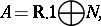 |
where  is the ideal of all nilpotent elements in
  . The smallest
  with the property
  is called the depth, or order, of
  .
.
In other words, one may also characterize the Weil algebras as the formally real and local (i.e. the ring structure is local, cf. also Local ring) finite-dimensional commutative real unital algebras. See [a2], 35.1, for details.
As a consequence of the Nakayama lemma, the Weil algebras can be also characterized as the local finite-dimensional quotients of the algebras of real polynomials  . Consequently, the Weil algebras
  correspond to choices of ideals
  in
in  of finite codimension. The algebra of Study numbers
  is given by
  , for example. Equivalently, one may consider the algebras of formal power series or the algebras of germs of smooth functions at the origin
  (cf. also Germ) instead of the polynomials.
The width of a Weil algebra  is defined as the dimension of the vector space
  . If
. If  is an ideal of finite codimension in
  ,
, 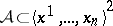 , then the width of
  equals
  . For example, the Weil algebra
 |
has width  and order
  , and it coincides with the algebra
  of
of  -jets of smooth functions at the origin in
  . Moreover, each Weil algebra of width
  and order
  is a quotient of
  .
.
Tensor products of Weil algebras are Weil algebras again. For instance,  .
.
The infinitesimal objects of type  attached to points in
  are simply
  . All smooth functions
  extend to
  by the evaluation of the Taylor series (cf. also Whitney extension theorem)
 |
where  ,
,  ,
,  are multi-indices,
  . Applying this formula to all components of a mapping
  , one obtains an assignment functorial in both
  and
and  . Of course, this definition extends to a functor on all locally defined smooth mappings
  and so each Weil algebra gives rise to a Weil functor
  . (See Weil bundle for more details.)
The automorphism group  of a Weil algebra is a Lie subgroup (cf. also Lie group) in
  and its Lie algebra coincides with the space of all derivations (cf. also Derivation in a ring) on
  ,
,  , i.e. all mappings
  satisfying
  , cf. [a2], 42.9.
References
| [a1] | Ch. Ehresmann, "Les prolongements d'une variété différentiable. I. Calcul des jets, prolongement principal. II. L'espace des jets d'ordre  de de  dans dans  . III. Transitivité des prolongements" C.R. Acad. Sci. Paris , 233 (1951) pp. 598–600; 777–779; 1081–1083 MR0045436 MR0045435 MR0044198 . III. Transitivité des prolongements" C.R. Acad. Sci. Paris , 233 (1951) pp. 598–600; 777–779; 1081–1083 MR0045436 MR0045435 MR0044198 |
| [a2] | I. Kolář, P.W. Michor, J. Slovák, "Natural operations in differential geometry" , Springer (1993) MR1202431 Zbl 1084.53001 |
| [a3] | A. Weil, "Théorie des points proches sur les variétés differentielles" Colloq. Internat. Centre Nat. Rech. Sci. , 52 (1953) pp. 111–117 |
Weil algebra. Encyclopedia of Mathematics. URL: http://encyclopediaofmath.org/index.php?title=Weil_algebra&oldid=18951