Difference between revisions of "Leibniz-Hopf algebra"
(Importing text file) |
Ulf Rehmann (talk | contribs) m (moved Leibniz–Hopf algebra to Leibniz-Hopf algebra: ascii title) |
(No difference)
| |
Revision as of 18:53, 24 March 2012
Let  be the free associative algebra on
  over the integers. Give
  a Hopf algebra structure by means of the following co-multiplication, augmentation, and antipode:
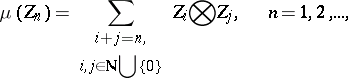 |
where
 |
 |
 |
where the sum is over all strings  ,
,  , such that
  . This makes
  a Hopf algebra, called the Leibniz–Hopf algebra. This Hopf algebra is important, e.g., in the theory of curves of non-commutative formal groups (see Formal group) [a1], [a2], [a5]. Its commutative quotient
  , with the same co-multiplication, is the underlying Hopf algebra of the (big) Witt vector functor
  (see Witt vector) and it plays an important role in the classification theory of unipotent commutative algebraic groups and in the theory of commutative formal groups (amongst other things) [a3].
The Leibniz–Hopf algebra  is free as a
  -module and graded. Its graded dual is also a Hopf algebra, whose underlying algebra is the overlapping shuffle algebra
  . As a
  -module,
  is free with basis
  , the free monoid (see Free semi-group) of all words in the alphabet
  with the duality pairing
  given by
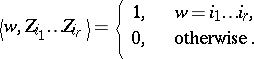 |
The overlapping shuffle product of two such words  ,
,  is equal to
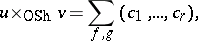 |
where the sum is over all  and pairs of order-preserving injective mappings
  ,
,  such that
  , and where
 |
with  if
if  , and similarly for
  .
.
For example,
 |
 |
The terms of maximal length of the overlapping shuffle product form the shuffle product, see Shuffle algebra.
A word  ,
,  , is elementary if the greatest common divisor of
  is
is  . With this terminology, the Ditters–Scholtens theorem [a4], [a5] says that, as an algebra over
  , the overlapping shuffle algebra
  is the free commutative polynomial algebra with as generators the elementary concatenation powers of elementary Lyndon words (see Lyndon word). (E.g., the third concatenation power of
  is
is  .) In contrast with the case of the shuffle algebra, this theorem already holds over
  (not just over
  ).
).
References
| [a1] | E.J. Ditters, "Curves and formal (co)groups" Invent. Math. , 17 (1972) pp. 1–20 |
| [a2] | E.J. Ditters, "Groupes formels" , Lecture Notes , Univ. Paris XI: Orsay (1974) |
| [a3] | M. Hazewinkel, "Formal groups and applications" , Acad. Press (1978) |
| [a4] | M. Hazewinkel, "The Leibniz Hopf algebra and Lyndon words" Preprint AM CWI , 9612 (1996) |
| [a5] | A.C.J. Scholtens, " -Typical curves in non-commutative Hopf algebras" , Free Univ. Amsterdam (1996) (Thesis) -Typical curves in non-commutative Hopf algebras" , Free Univ. Amsterdam (1996) (Thesis) |
Leibniz-Hopf algebra. Encyclopedia of Mathematics. URL: http://encyclopediaofmath.org/index.php?title=Leibniz-Hopf_algebra&oldid=14247