Difference between revisions of "Bipolar coordinates"
(Importing text file) |
m (OldImage template added) |
||
| (One intermediate revision by one other user not shown) | |||
| Line 1: | Line 1: | ||
| − | + | <!-- | |
| + | b0164701.png | ||
| + | $#A+1 = 29 n = 0 | ||
| + | $#C+1 = 29 : ~/encyclopedia/old_files/data/B016/B.0106470 Bipolar coordinates | ||
| + | Automatically converted into TeX, above some diagnostics. | ||
| + | Please remove this comment and the {{TEX|auto}} line below, | ||
| + | if TeX found to be correct. | ||
| + | --> | ||
| − | + | {{TEX|auto}} | |
| + | {{TEX|done}} | ||
| − | + | The numbers $ \tau $ | |
| + | and $ \sigma $ | ||
| + | which are connected with the Cartesian orthogonal coordinates $ x $ | ||
| + | and $ y $ | ||
| + | by the formulas | ||
| + | |||
| + | $$ | ||
| + | x = | ||
| + | \frac{a \sinh \tau }{\cosh \tau - \cos \sigma } | ||
| + | ,\ \ | ||
| + | y = | ||
| + | \frac{a \sin \sigma }{\cosh \tau - \cos \sigma } | ||
| + | , | ||
| + | $$ | ||
| + | |||
| + | where $ 0 \leq \sigma < \pi , -\infty < \tau < \infty $. | ||
| + | The coordinate lines are two families of circles $ ( \tau = \textrm{ const } ) $ | ||
| + | with poles $ A $ | ||
| + | and $ B $ | ||
| + | and the (half-c)ircles orthogonal with these $ ( \sigma = \textrm{ const } ) $. | ||
<img style="border:1px solid;" src="https://www.encyclopediaofmath.org/legacyimages/common_img/b016470a.gif" /> | <img style="border:1px solid;" src="https://www.encyclopediaofmath.org/legacyimages/common_img/b016470a.gif" /> | ||
| Line 11: | Line 38: | ||
The Lamé coefficients are: | The Lamé coefficients are: | ||
| − | + | $$ | |
| + | L _ \tau = L _ \sigma = \ | ||
| + | |||
| + | \frac{a ^ {2} }{( \cosh \tau - \cos \sigma ) ^ {2} } | ||
| + | . | ||
| + | $$ | ||
The Laplace operator is: | The Laplace operator is: | ||
| − | + | $$ | |
| + | \Delta f = | ||
| + | \frac{1}{a ^ {2} } | ||
| + | |||
| + | ( \cosh \tau - \cos \sigma ) ^ {2} | ||
| + | \left ( | ||
| + | |||
| + | \frac{\partial ^ {2} f }{\partial \sigma ^ {2} } | ||
| + | + | ||
| + | |||
| + | \frac{\partial ^ {2} f }{\partial \tau ^ {2} } | ||
| + | \ | ||
| + | \right ) . | ||
| + | $$ | ||
| − | Bipolar coordinates in space (bispherical coordinates) are the numbers | + | Bipolar coordinates in space (bispherical coordinates) are the numbers $ \sigma , \tau $ |
| + | and $ \phi $, | ||
| + | which are connected with the orthogonal Cartesian coordinates $ x, y $ | ||
| + | and $ z $ | ||
| + | by the formulas: | ||
| − | + | $$ | |
| + | x = | ||
| + | \frac{a \sin \sigma \cos \phi }{\cosh \tau - \cos \sigma } | ||
| + | , | ||
| + | $$ | ||
| − | + | $$ | |
| + | y = | ||
| + | \frac{a \sin \sigma \sin \phi }{\cosh \tau - \cos \sigma } | ||
| + | , | ||
| + | $$ | ||
| − | + | $$ | |
| + | z = | ||
| + | \frac{a \sinh \tau }{\cosh \tau - \cos \sigma } | ||
| + | , | ||
| + | $$ | ||
| − | where < | + | where $ - \infty < \sigma < \infty , 0 \leq \tau < \pi , 0 \leq \phi < 2 \pi $. |
| + | The coordinate surfaces are spheres ( $ \sigma = \textrm{ const } $), | ||
| + | the surfaces obtained by rotation of arcs of circles ( $ \tau = \textrm{ const } $) | ||
| + | and half-planes passing through the $ Oz $- | ||
| + | axis. The system of bipolar coordinates in space is formed by rotating the system of bipolar coordinates on the plane $ Oxy $ | ||
| + | around the $ Oz $- | ||
| + | axis. | ||
The Lamé coefficients are: | The Lamé coefficients are: | ||
| − | + | $$ | |
| + | L _ \sigma = \ | ||
| + | L _ \tau = \ | ||
| − | + | \frac{a ^ {2} }{( \cosh \tau - \cos \sigma ) ^ {2} } | |
| + | , | ||
| + | $$ | ||
| + | |||
| + | $$ | ||
| + | L _ \phi = | ||
| + | \frac{a ^ {2} \sin ^ {2} \sigma }{( \cosh \tau - \cos \sigma ) ^ {2} } | ||
| + | . | ||
| + | $$ | ||
The Laplace operator is: | The Laplace operator is: | ||
| − | + | $$ | |
| + | \Delta f = \ | ||
| − | + | \frac{( \cosh \tau - \cosh \sigma ) ^ {3} }{a ^ {2} \sin \sigma } | |
| + | \left [ | ||
| − | + | \frac \partial {\partial \tau } | |
| − | + | \left ( | |
| + | |||
| + | \frac{\sin \sigma }{\cosh \tau - \cos \sigma } | ||
| + | \frac{\partial f }{\partial \tau } | ||
| + | \ | ||
| + | \right )\right . + | ||
| + | $$ | ||
| + | $$ | ||
| + | + \left . | ||
| − | + | \frac \partial {\partial \sigma } | |
| + | \left ( | ||
| + | \frac{\sin \sigma | ||
| + | }{\cosh \tau - \cos \sigma } | ||
| + | |||
| + | \frac{\partial f }{\partial \sigma } | ||
| + | \right ) + | ||
| + | \frac{1}{\sin \sigma ( \cosh \tau - \cos | ||
| + | \sigma ) } | ||
| + | |||
| + | \frac{\partial ^ {2} f }{\partial \phi ^ {2} } | ||
| + | \right ] . | ||
| + | $$ | ||
====References==== | ====References==== | ||
| − | <table><TR><TD valign="top">[a1]</TD> <TD valign="top"> O. Veblen, J.H.C. Whitehead, "The foundations of differential geometry" , Cambridge Univ. Press (1932)</TD></TR></table> | + | <table> |
| + | <TR><TD valign="top">[1]</TD> <TD valign="top"> E. Madelung, "Die mathematischen Hilfsmittel des Physikers" , Springer (1957)</TD></TR> | ||
| + | <TR><TD valign="top">[a1]</TD> <TD valign="top"> O. Veblen, J.H.C. Whitehead, "The foundations of differential geometry" , Cambridge Univ. Press (1932)</TD></TR> | ||
| + | </table> | ||
| + | |||
| + | {{OldImage}} | ||
Latest revision as of 08:18, 26 March 2023
The numbers $ \tau $
and $ \sigma $
which are connected with the Cartesian orthogonal coordinates $ x $
and $ y $
by the formulas
$$ x = \frac{a \sinh \tau }{\cosh \tau - \cos \sigma } ,\ \ y = \frac{a \sin \sigma }{\cosh \tau - \cos \sigma } , $$
where $ 0 \leq \sigma < \pi , -\infty < \tau < \infty $. The coordinate lines are two families of circles $ ( \tau = \textrm{ const } ) $ with poles $ A $ and $ B $ and the (half-c)ircles orthogonal with these $ ( \sigma = \textrm{ const } ) $.
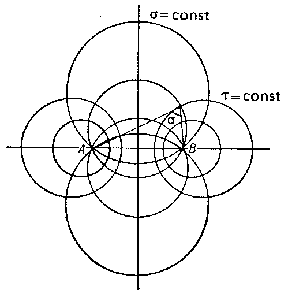
Figure: b016470a
The Lamé coefficients are:
$$ L _ \tau = L _ \sigma = \ \frac{a ^ {2} }{( \cosh \tau - \cos \sigma ) ^ {2} } . $$
The Laplace operator is:
$$ \Delta f = \frac{1}{a ^ {2} } ( \cosh \tau - \cos \sigma ) ^ {2} \left ( \frac{\partial ^ {2} f }{\partial \sigma ^ {2} } + \frac{\partial ^ {2} f }{\partial \tau ^ {2} } \ \right ) . $$
Bipolar coordinates in space (bispherical coordinates) are the numbers $ \sigma , \tau $ and $ \phi $, which are connected with the orthogonal Cartesian coordinates $ x, y $ and $ z $ by the formulas:
$$ x = \frac{a \sin \sigma \cos \phi }{\cosh \tau - \cos \sigma } , $$
$$ y = \frac{a \sin \sigma \sin \phi }{\cosh \tau - \cos \sigma } , $$
$$ z = \frac{a \sinh \tau }{\cosh \tau - \cos \sigma } , $$
where $ - \infty < \sigma < \infty , 0 \leq \tau < \pi , 0 \leq \phi < 2 \pi $. The coordinate surfaces are spheres ( $ \sigma = \textrm{ const } $), the surfaces obtained by rotation of arcs of circles ( $ \tau = \textrm{ const } $) and half-planes passing through the $ Oz $- axis. The system of bipolar coordinates in space is formed by rotating the system of bipolar coordinates on the plane $ Oxy $ around the $ Oz $- axis.
The Lamé coefficients are:
$$ L _ \sigma = \ L _ \tau = \ \frac{a ^ {2} }{( \cosh \tau - \cos \sigma ) ^ {2} } , $$
$$ L _ \phi = \frac{a ^ {2} \sin ^ {2} \sigma }{( \cosh \tau - \cos \sigma ) ^ {2} } . $$
The Laplace operator is:
$$ \Delta f = \ \frac{( \cosh \tau - \cosh \sigma ) ^ {3} }{a ^ {2} \sin \sigma } \left [ \frac \partial {\partial \tau } \left ( \frac{\sin \sigma }{\cosh \tau - \cos \sigma } \frac{\partial f }{\partial \tau } \ \right )\right . + $$
$$ + \left . \frac \partial {\partial \sigma } \left ( \frac{\sin \sigma }{\cosh \tau - \cos \sigma } \frac{\partial f }{\partial \sigma } \right ) + \frac{1}{\sin \sigma ( \cosh \tau - \cos \sigma ) } \frac{\partial ^ {2} f }{\partial \phi ^ {2} } \right ] . $$
References
| [1] | E. Madelung, "Die mathematischen Hilfsmittel des Physikers" , Springer (1957) |
| [a1] | O. Veblen, J.H.C. Whitehead, "The foundations of differential geometry" , Cambridge Univ. Press (1932) |
Bipolar coordinates. Encyclopedia of Mathematics. URL: http://encyclopediaofmath.org/index.php?title=Bipolar_coordinates&oldid=11655