Lax-Milgram lemma
Many boundary-value problems for ordinary and partial differential equations can be posed in the following abstract variational form (cf. also Boundary value problem, ordinary differential equations; Boundary value problem, partial differential equations): Find  such that
 | (a1) |
where  is a normed linear space (cf. also Norm),
  denotes a functional on
  and
and  is an element in
  (the dual of
  ).
).
The essential question here is what conditions can be imposed on  and the normed space
  so that a unique solution to (a1) exists and depends continuously on the data
  .
.
The first result in this direction was obtained in 1954 by P.D. Lax and A.N. Milgram [a1], who established sufficient conditions for the existence and uniqueness of the solution for (a1).
Let  be a reflexive Banach space (cf. also Reflexive space) and let $b:V\times V\longrightarrow\mathbb{C}$ be a sesquilinear mapping (bilinear when
  is real; cf. also Sesquilinear form) such that
 |
(continuity) and
 |
(strong coercivity), where  . Then there exists a unique bijective linear mapping
  , continuous in both directions and uniquely determined by
  , with
 |
 |
and for the norms one has:
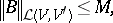 |
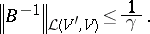 |
This implies that  is the solution of (a1). The above theorem only establishes existence of a solution to (a1), namely
  , but does not say anything about the construction of this solution. In 1965, W.V. Petryshyn [a2] proved the following result: Let
  be a separable reflexive Banach space (cf. also Separable space),
  a basis of
  and
and  a continuous sesquilinear strongly coercive mapping on
  . Then for all
  :
:
i) for all  the system
 |
is uniquely solvable for  ;
;
ii) the sequence  determined by
 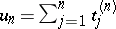 converges in
  to a
to a  that is the solution of (a1).
To see that the strong coerciveness property of the sesquilinear mapping  is not necessary for the existence of the solution to (a1), consider the following very simple example.
Let  be defined by
 |
where  ,
,  . It is easy to see that
  is bilinear and continuous. It is not strongly coercive, because
  when
when 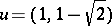 . However, for all
  ,
,
 |
is the unique solution to (a1).
In 1971, I. Babuška [a3] gave a significant generalization of the Lax–Milgram theorem using weak coerciveness (cf. Babuška–Lax–Milgram theorem).
An extensive literature exists on applications of the Lax–Milgram lemma to various classes of boundary-value problems (see, e.g., [a4], [a5]).
References
| [a1] | P.D. Lax, A.N. Milgram, "Parabolic equations" Ann. Math. Studies , 33 (1954) pp. 167–190 |
| [a2] | W.V. Petryshyn, "Constructional proof of Lax–Milgram lemma and its applications to non-k-p.d. abstract and differential operator equation" SIAM Numer. Anal. Ser. B , 2 : 3 (1965) pp. 404–420 |
| [a3] | I. Babuška, "Error bound for the finite element method" Numer. Math. , 16 (1971) pp. 322–333 |
| [a4] | J.T. Oden, J.N. Reddy, "An introduction to the mathematical theory of finite elements" , Wiley (1976) |
| [a5] | J. Nečas, "Les méthodes directes dans la théorie des équations elliptiques" , Masson (1967) |
Lax-Milgram lemma. Encyclopedia of Mathematics. URL: http://encyclopediaofmath.org/index.php?title=Lax-Milgram_lemma&oldid=27194