Extension of an operator
A linear operator whose graph contains the graph of the given linear operator. When the operator  is an extension of a given operator
  , one writes
  . The usual problems in the theory of extensions are as follows: extend an operator maximally while preserving a specific property, or study extensions of an operator having various additional properties.
For example, let  be a given isometric operator on a Hilbert space
  with domain of definition
  and range of values
  ; then the isometric extensions of
  are in one-to-one correspondence with the isometric mappings from
 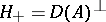 to
to 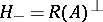 . In particular,
  has unitary extensions if the dimensions of
  and
and  coincide.
Extensions of symmetric operators.
The most studied (and most important in applications) is the theory of self-adjoint extensions of symmetric operators on a Hilbert space. An operator  is symmetric if and only if
  , where
  is the operator adjoint to
  . Thus, the domain of definition of any symmetric extension of
  is contained in
  , and these extensions are restrictions of
  . This reduces the description of the symmetric extensions of
  to determining their domains of definition. A subspace
  is the domain of definition of some symmetric extension of
  if and only if
  for all
  . It turns out that
 |
where  are deficiency subspaces (defect subspaces) (their dimensions
  are called deficiency numbers (defect numbers)), and the symmetric extensions of
  are in one-to-one correspondence with the isometric mappings from
  to
to  : To any such mapping
  corresponds an extension of
  with domain of definition
  , where
  is the graph of
  . Self-adjoint extensions correspond to unitary operators
  , and hence exist if and only if the defect numbers are equal.
The domains of definition of extensions of symmetric operators can be conveniently described with the help of so-called (abstract) boundary conditions. Any linear functional on  , continuous relative to the norm
  , and equal to zero on
  , is called a boundary value for the symmetric operator
  ; an equation
  , where
  is a boundary value, is called a boundary condition. Boundary values are determined by their values on
  . If the defect numbers of a symmetric operator
  are finite, then each of its symmetric extensions
  is determined by a family of boundary conditions, that is,
  , where
  are boundary values. The families of boundary values determining self-adjoint extensions of
  with defect numbers
  can be described as follows. Let
  and
and  be orthonormal bases of
  and
and  , respectively, and let, for
  ,
,
 |
 |
Then any self-adjoint extension  of
of  is determined by the boundary conditions
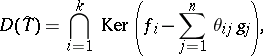 |
where  is a unitary
  -matrix.
In some cases one can successfully prove the existence of self-adjoint extensions (and find some of them) without solving the difficult problem of determining the defect subspaces and defect numbers. For example, if  commutes with an (anti-unitary) involution of the space
  , then it has a self-adjoint extension. This is often used in the theory of differential operators, where the involution is taken to be complex conjugation in the space
  . Equality of defect numbers also occurs in the case when
  has points of regular type on the real axis (
 is called a point of regular type if
  for some
  and for all
  ).
).
Extensions of semi-bounded operators.
An operator  is called semi-bounded from below by
  if its numerical range
  lies in the interval
  ; an operator is called positive if it is semi-bounded from below by zero. If
  is semi-bounded from below by
  , then every
  is a point of regular type, the defect numbers are equal and self-adjoint extensions exist. One such an extension can be constructed as follows. The sesquilinear form
  defined on
  admits a closure
  . But, being a closed symmetric bilinear form, to
  corresponds a unique self-adjoint operator
  such that
  . The operator
  is called the Friedrichs extension of the operator
  and is semi-bounded. The greatest lower bound of its spectrum is equal to the greatest lower bound of the numerical range of
  . This is the unique self-adjoint extension whose domain of definition is contained in the domain of definition of
  . Using the Friedrichs extension it is possible to describe other semi-bounded extensions of
  (if the defect numbers of
  are finite, then all its self-adjoint extensions are semi-bounded). For this it is sufficient to find all positive extensions of positive operators (the general case reduces to this by adding a multiple of the identity operator). Let
  be a positive operator and let
  . Then the positive self-adjoint extensions of
  correspond uniquely to positive bounded operators
  on
on  ; for every such operator
  , the subspace
  is the domain of definition of the corresponding extension (see ).
The construction of the Friedrichs extension can be generalized to the case of sectorial operators, i.e. operators whose numerical range is contained in some angle  . There is an extension, which is a maximal sectorial operator, whose numerical range lies in the same angle and which, like the Friedrichs extension, is minimal. The case of operators from a Banach space into its dual space has also been studied (see [5]).
Dissipative extensions.
In some problems it is necessary to construct symmetric extensions of symmetric operators. A typical result is as follows. An operator  is called dissipative if its numerical range lies in the left half-plane, and maximal dissipative if it is dissipative and does not have dissipative extensions. Every symmetric operator has an extension of the form
  , where
  is a maximal dissipative operator; all such extensions can be described by means of contractive mappings of
  into
into  (see [8]).
Extensions of differential operators.
The theory of extensions of operators has important applications in the study of differential operators. Let
 |
be a formal self-adjoint differential expression on the interval  , let
, let  be the subspace consisting of all functions with absolutely-continuous quasi-derivatives of orders
  , and
, and  -th quasi-derivative in
  , and let
  be the subspace of
  consisting of the functions whose supports do not contain the end points of the intervals. Let
  be the operator given by
  for
for  , and let
  be its restriction to
  . Then
  is symmetric,
  ; let
; let  be its closure. In the regular case (that is, when the interval
  is finite and the function
  is summable), the domain of definition of
  is formed by all functions in
  whose first
  quasi-derivatives vanish at the end points of the interval. In the singular case,
  is harder to describe (see [2]). The defect numbers of
  coincide and are equal to
  in the regular case and are at most
  in the singular case. Thus,
  always has self-adjoint extensions; their spectra, spectral decompositions and resolvents are the basic objects of study in the theory of differential operators, because the choice of this or that self-adjoint extension is in fact the precise formulation of a certain spectral problem. This is particularly clear in the regular case, when the (abstract) boundary conditions, giving the domain of definition of a self-adjoint extension of
  , are written in the form of ordinary boundary conditions:
 |
for some  ,
,  (this follows from the above description of (abstract) boundary conditions since, in the regular case, the boundary values are determined by
  ,
,  ).
).
For  ,
,  is semi-bounded from below, and its Friedrichs extension corresponds to the boundary conditions
  ,
,  .
.
In the general case, the self-adjoint extensions of  can be characterized as follows. Let
 |
for all functions  and
and  from
from  . Then the limits
 |
exist and satisfy
 |
(Lagrange's formula). Thus, to describe the self-adjoint extensions of  it is sufficient to choose bases
  and
and  of the defect subspaces
  and
and  (it is convenient to assume that
  ) and to put every unitary matrix
  into correspondence with the self-adjoint extension
  whose domain of definition consists of all functions
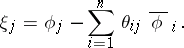
  that satisfy the boundary conditions
 |
where
 |
Extensions corresponding to boundary value problems.
Extensions of semi-bounded operators play a central role in the theory of elliptic boundary value problems. For example, let  be an elliptic differential expression of the second order in a region
  of the
  -dimensional space, and let
  and
and  be the minimal and maximal operators determined by this expression. Then
  is positive definite, its defect numbers are infinite and the defect subspace
  (called the space of
  -harmonic functions on
  ) has a natural realization as a function space on the boundary
  of
of  . Thus, various extensions of
  correspond to various boundary conditions and thus determine various boundary value problems. In particular, the Friedrichs extension
  is defined on all functions in the Sobolev space
  that vanish on
  , and the equation
  corresponds to the Dirichlet problem:
 |
The theory of partial differential equations gives rise to a number of general questions about extensions of symmetric operators, such as the question of uniqueness of a self-adjoint extension (so-called essential self-adjointness), whether operators that commute (in some sense) have commuting extensions, whether there exist intermediate extensions with given properties (for example, with conditions on the spectrum), etc. (see [7]–[9]).
Extensions into an enlarged Hilbert space.
Every symmetric operator acting on a Hilbert space  can be extended to a self-adjoint operator acting on some space
  (see [10]), and so every symmetric operator has a generalized spectral function. This is related to various results on extensions from a space and on dilatations (see [11]). Thus, any contraction of a Hilbert space (that is, any operator of norm
  ) can be extended to a co-isometric operator (that is, the adjoint of an isometric operator), and every contraction whose powers strongly converge to zero can be extended to a backwards one-sided shift (that is, the adjoint of a one-sided shift). Results about extensions into an enlarged space can be generalized to commutative families, semi-groups, etc.
References
| [1] | N. Dunford, J.T. Schwartz, "Linear operators. Spectral theory" , 2 , Interscience (1963) |
| [2] | M.A. Naimark, "Lineare Differentialoperatoren" , Akademie Verlag (1960) (Translated from Russian) |
| [3] | T. Kato, "Perturbation theory for linear operators" , Springer (1966) pp. Chapt. X Sect. 3 |
| [4a] | M.G. Krein, "Theory of selfadjoint extensions of semibounded Hermitian transformations and its applications I" Mat. Sb. , 20 (1947) pp. 431–498 (In Russian) |
| [4b] | M.G. Krein, "Theory of selfadjoint extensions of semibounded Hermitian transformations and its applications II" Mat. Sb. , 21 (1947) pp. 365–404 (In Russian) |
| [5] | M.Sh. Birman, "On the theory of selfadjoint extensions of positive definite operators" Mat. Sb. , 38 (1956) pp. 431–450 (In Russian) |
| [6] | R.S. Phillips, "Dissipative operators and hyperbolic systems of partial differential equations" Trans. Amer. Math. Soc. , 90 : 2 (1959) pp. 193–254 |
| [7] | K. Moren, "Methods of Hilbert spaces" , PWN (1967) (Translated from Polish) |
| [8] | Yu.M. [Yu.M. Berezanskii] Berezanskiy, "Expansion in eigenfunctions of selfadjoint operators" , Amer. Math. Soc. (1968) (Translated from Russian) |
| [9] | S.G. Mikhlin, "The problem of the minimum of a quadratic functional" , Holden-Day (1965) (Translated from Russian) |
| [10] | M.A. Naimark, "Spectral functions of a symmetric operator" Izv. Akad. Nauk SSSR Ser. Mat. , 4 (1940) pp. 277–318 (In Russian) |
| [11] | B. Szökefalvi-Nagy, Ch. Foiaş, "Harmonic analysis of operators on Hilbert spaces" , North-Holland (1970) (Translated from French) |
| [12] | L. Brown, R. Douglas, P. Fillmore, "Unitary equivalence modulo the compact operators and extensions of  -algebras" , Proc. Conf. Operator Theory , Lect. notes in math. , 345 , Springer (1973) pp. 58–128 -algebras" , Proc. Conf. Operator Theory , Lect. notes in math. , 345 , Springer (1973) pp. 58–128 |
| [13] | W. Arveson, "Notes on extensions of  -algebras" Duke Math. J. , 44 : 2 (1977) pp. 329–355 -algebras" Duke Math. J. , 44 : 2 (1977) pp. 329–355 |
| [14] | M. Reed, B. Simon, "Methods of contemporary mathematical physics" , II: Fourier analysis, self-adjointness , Acad. Press (1975) |
Comments
The notation  is another occasionally used notation for the (internal) direct sum
  , i.e.
  signifies that
  and
and  .
.
When dealing with a differential expression
 | (a1) |
it may happen that  makes sense even though not all derivatives
  ,
,  , exist; this is connected with possible non-differentiability of the coefficients
  . One therefore defines the quasi-derivatives
  of
of  corresponding to the expression (a1) above by the formulas
 |
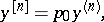 |
 |
In addition one sets  . Thus,
  .
.
There exists another class of problems which go by the name of extension problems. These are matrix extension problems and operator extension problems, in which the matrices (operators) are incompletely given and it is required to "fill-in" the missing "entries" in such a way that the resulting matrix (operator) has certain specified properties. For instance, in one finite version of the Carathéodory–Toeplitz problem one has given a band around the diagonal of an  -matrix
  :
:  ,
,  , such that
  (and some other necessary conditions), and it is required to find the remaining
  such that the resulting matrix has non-negative definite real part. There is a corresponding infinite version which is important in signal analysis.
Such problems relate to the interpolation of operators.
Extension of an operator. Encyclopedia of Mathematics. URL: http://encyclopediaofmath.org/index.php?title=Extension_of_an_operator&oldid=17795