Integral cosine
The special function defined, for real  , by
, by
 |
where  is the Euler constant. Its graph is:
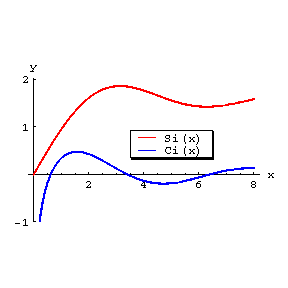
Figure: i051370a
The graphs of the functions  and
and  .
.
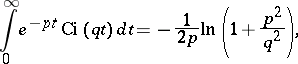
Some integrals related to the integral cosine are:
 |
 |
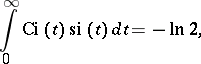 |
where  is the integral sine minus
  .
.
For  small:
 |
The asymptotic representation, for  large, is:
 |
 |
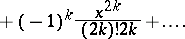
The integral cosine has the series representation:
 | (*) |
 |
As a function of the complex variable  ,
,  , defined by (*), is a single-valued analytic function in the
  -plane with slit along the relative negative real axis
  . The value of
  here is taken to be
  . The behaviour of
  near the slit is determined by the limits
 |
The integral cosine is related to the integral exponential function  by
by
 |
One sometimes uses the notation  .
.
See also Si-ci-spiral.
References
| [1] | H. Bateman (ed.) A. Erdélyi (ed.) et al. (ed.) , Higher transcendental functions , 2. Bessel functions, parabolic cylinder functions, orthogonal polynomials , McGraw-Hill (1953) |
| [2] | E. Jahnke, F. Emde, "Tables of functions with formulae and curves" , Dover, reprint (1945) (Translated from German) |
| [3] | A. Kratzer, W. Franz, "Transzendente Funktionen" , Akademie Verlag (1960) |
| [4] | N.N. Lebedev, "Special functions and their applications" , Prentice-Hall (1965) (Translated from Russian) |
Comments
The function  is better known as the cosine integral. It can, of course, be defined by the integral (as above) in
  .
.
Integral cosine. Encyclopedia of Mathematics. URL: http://encyclopediaofmath.org/index.php?title=Integral_cosine&oldid=47367