Difference between revisions of "Orthogonal matrix"
Ulf Rehmann (talk | contribs) m (tex encoded by computer) |
Ulf Rehmann (talk | contribs) m (Undo revision 48075 by Ulf Rehmann (talk)) Tag: Undo |
||
| Line 1: | Line 1: | ||
| − | < | + | A [[Matrix|matrix]] over a commutative ring <img align="absmiddle" border="0" src="https://www.encyclopediaofmath.org/legacyimages/o/o070/o070320/o0703201.png" /> with identity <img align="absmiddle" border="0" src="https://www.encyclopediaofmath.org/legacyimages/o/o070/o070320/o0703202.png" /> for which the [[Transposed matrix|transposed matrix]] coincides with the inverse. The determinant of an orthogonal matrix is equal to <img align="absmiddle" border="0" src="https://www.encyclopediaofmath.org/legacyimages/o/o070/o070320/o0703203.png" />. The set of all orthogonal matrices of order <img align="absmiddle" border="0" src="https://www.encyclopediaofmath.org/legacyimages/o/o070/o070320/o0703204.png" /> over <img align="absmiddle" border="0" src="https://www.encyclopediaofmath.org/legacyimages/o/o070/o070320/o0703205.png" /> forms a subgroup of the [[General linear group|general linear group]] <img align="absmiddle" border="0" src="https://www.encyclopediaofmath.org/legacyimages/o/o070/o070320/o0703206.png" />. For any real orthogonal matrix <img align="absmiddle" border="0" src="https://www.encyclopediaofmath.org/legacyimages/o/o070/o070320/o0703207.png" /> there is a real orthogonal matrix <img align="absmiddle" border="0" src="https://www.encyclopediaofmath.org/legacyimages/o/o070/o070320/o0703208.png" /> such that |
| − | o0703201.png | ||
| − | |||
| − | |||
| − | |||
| − | |||
| − | |||
| − | |||
| − | + | <table class="eq" style="width:100%;"> <tr><td valign="top" style="width:94%;text-align:center;"><img align="absmiddle" border="0" src="https://www.encyclopediaofmath.org/legacyimages/o/o070/o070320/o0703209.png" /></td> </tr></table> | |
| − | |||
| − | |||
| − | |||
| − | |||
| − | |||
| − | |||
| − | |||
| − | |||
| − | |||
| − | |||
| − | |||
| − | |||
| − | |||
| − | |||
| − | |||
where | where | ||
| − | + | <table class="eq" style="width:100%;"> <tr><td valign="top" style="width:94%;text-align:center;"><img align="absmiddle" border="0" src="https://www.encyclopediaofmath.org/legacyimages/o/o070/o070320/o07032010.png" /></td> </tr></table> | |
| − | |||
| − | A non-singular complex matrix | + | A non-singular complex matrix <img align="absmiddle" border="0" src="https://www.encyclopediaofmath.org/legacyimages/o/o070/o070320/o07032011.png" /> is similar to a complex orthogonal matrix if and only if its system of [[Elementary divisors|elementary divisors]] possesses the following properties: |
| − | is similar to a complex orthogonal matrix if and only if its system of [[Elementary divisors|elementary divisors]] possesses the following properties: | ||
| − | 1) for | + | 1) for <img align="absmiddle" border="0" src="https://www.encyclopediaofmath.org/legacyimages/o/o070/o070320/o07032012.png" />, the elementary divisors <img align="absmiddle" border="0" src="https://www.encyclopediaofmath.org/legacyimages/o/o070/o070320/o07032013.png" /> and <img align="absmiddle" border="0" src="https://www.encyclopediaofmath.org/legacyimages/o/o070/o070320/o07032014.png" /> are repeated the same number of times; |
| − | the elementary divisors | ||
| − | and | ||
| − | are repeated the same number of times; | ||
| − | 2) each elementary divisor of the form | + | 2) each elementary divisor of the form <img align="absmiddle" border="0" src="https://www.encyclopediaofmath.org/legacyimages/o/o070/o070320/o07032015.png" /> is repeated an even number of times. |
| − | is repeated an even number of times. | ||
====References==== | ====References==== | ||
<table><TR><TD valign="top">[1]</TD> <TD valign="top"> A.I. Mal'tsev, "Foundations of linear algebra" , Freeman (1963) (Translated from Russian)</TD></TR></table> | <table><TR><TD valign="top">[1]</TD> <TD valign="top"> A.I. Mal'tsev, "Foundations of linear algebra" , Freeman (1963) (Translated from Russian)</TD></TR></table> | ||
| + | |||
| + | |||
====Comments==== | ====Comments==== | ||
| − | The mapping | + | The mapping <img align="absmiddle" border="0" src="https://www.encyclopediaofmath.org/legacyimages/o/o070/o070320/o07032016.png" /> defined by an orthogonal matrix <img align="absmiddle" border="0" src="https://www.encyclopediaofmath.org/legacyimages/o/o070/o070320/o07032017.png" /> with respect to the standard basis, <img align="absmiddle" border="0" src="https://www.encyclopediaofmath.org/legacyimages/o/o070/o070320/o07032018.png" />, <img align="absmiddle" border="0" src="https://www.encyclopediaofmath.org/legacyimages/o/o070/o070320/o07032019.png" />, preserves the standard inner product and hence defines an orthogonal mapping. More generally, if <img align="absmiddle" border="0" src="https://www.encyclopediaofmath.org/legacyimages/o/o070/o070320/o07032020.png" /> and <img align="absmiddle" border="0" src="https://www.encyclopediaofmath.org/legacyimages/o/o070/o070320/o07032021.png" /> are inner product spaces with inner products <img align="absmiddle" border="0" src="https://www.encyclopediaofmath.org/legacyimages/o/o070/o070320/o07032022.png" />, <img align="absmiddle" border="0" src="https://www.encyclopediaofmath.org/legacyimages/o/o070/o070320/o07032023.png" />, then a linear mapping <img align="absmiddle" border="0" src="https://www.encyclopediaofmath.org/legacyimages/o/o070/o070320/o07032024.png" /> such that <img align="absmiddle" border="0" src="https://www.encyclopediaofmath.org/legacyimages/o/o070/o070320/o07032025.png" /> is called an orthogonal mapping. |
| − | defined by an orthogonal matrix | ||
| − | with respect to the standard basis, | ||
| − | |||
| − | preserves the standard inner product and hence defines an orthogonal mapping. More generally, if | ||
| − | and | ||
| − | are inner product spaces with inner products | ||
| − | |||
| − | then a linear mapping | ||
| − | such that | ||
| − | is called an orthogonal mapping. | ||
| − | Any non-singular (complex or real) matrix | + | Any non-singular (complex or real) matrix <img align="absmiddle" border="0" src="https://www.encyclopediaofmath.org/legacyimages/o/o070/o070320/o07032026.png" /> admits a [[Polar decomposition|polar decomposition]] <img align="absmiddle" border="0" src="https://www.encyclopediaofmath.org/legacyimages/o/o070/o070320/o07032027.png" /> with <img align="absmiddle" border="0" src="https://www.encyclopediaofmath.org/legacyimages/o/o070/o070320/o07032028.png" /> and <img align="absmiddle" border="0" src="https://www.encyclopediaofmath.org/legacyimages/o/o070/o070320/o07032029.png" /> symmetric and <img align="absmiddle" border="0" src="https://www.encyclopediaofmath.org/legacyimages/o/o070/o070320/o07032030.png" /> and <img align="absmiddle" border="0" src="https://www.encyclopediaofmath.org/legacyimages/o/o070/o070320/o07032031.png" /> orthogonal. |
| − | admits a [[Polar decomposition|polar decomposition]] | ||
| − | with | ||
| − | and | ||
| − | symmetric and | ||
| − | and | ||
| − | orthogonal. | ||
====References==== | ====References==== | ||
<table><TR><TD valign="top">[a1]</TD> <TD valign="top"> F.R. [F.R. Gantmakher] Gantmacher, "The theory of matrices" , '''1''' , Chelsea, reprint (1959) pp. 263ff (Translated from Russian)</TD></TR><TR><TD valign="top">[a2]</TD> <TD valign="top"> W. Noll, "Finite dimensional spaces" , M. Nijhoff (1987) pp. Sect. 43</TD></TR><TR><TD valign="top">[a3]</TD> <TD valign="top"> H.W. Turnball, A.C. Aitken, "An introduction to the theory of canonical matrices" , Blackie & Son (1932)</TD></TR></table> | <table><TR><TD valign="top">[a1]</TD> <TD valign="top"> F.R. [F.R. Gantmakher] Gantmacher, "The theory of matrices" , '''1''' , Chelsea, reprint (1959) pp. 263ff (Translated from Russian)</TD></TR><TR><TD valign="top">[a2]</TD> <TD valign="top"> W. Noll, "Finite dimensional spaces" , M. Nijhoff (1987) pp. Sect. 43</TD></TR><TR><TD valign="top">[a3]</TD> <TD valign="top"> H.W. Turnball, A.C. Aitken, "An introduction to the theory of canonical matrices" , Blackie & Son (1932)</TD></TR></table> | ||
Revision as of 14:52, 7 June 2020
A matrix over a commutative ring  with identity
  for which the transposed matrix coincides with the inverse. The determinant of an orthogonal matrix is equal to
  . The set of all orthogonal matrices of order
  over
over  forms a subgroup of the general linear group
  . For any real orthogonal matrix
  there is a real orthogonal matrix
  such that
 |
where
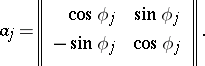 |
A non-singular complex matrix  is similar to a complex orthogonal matrix if and only if its system of elementary divisors possesses the following properties:
1) for  , the elementary divisors
  and
and  are repeated the same number of times;
2) each elementary divisor of the form  is repeated an even number of times.
References
| [1] | A.I. Mal'tsev, "Foundations of linear algebra" , Freeman (1963) (Translated from Russian) |
Comments
The mapping  defined by an orthogonal matrix
  with respect to the standard basis,
  ,
,  , preserves the standard inner product and hence defines an orthogonal mapping. More generally, if
  and
and  are inner product spaces with inner products
  ,
,  , then a linear mapping
  such that
  is called an orthogonal mapping.
Any non-singular (complex or real) matrix  admits a polar decomposition
  with
with  and
and  symmetric and
  and
and  orthogonal.
References
| [a1] | F.R. [F.R. Gantmakher] Gantmacher, "The theory of matrices" , 1 , Chelsea, reprint (1959) pp. 263ff (Translated from Russian) |
| [a2] | W. Noll, "Finite dimensional spaces" , M. Nijhoff (1987) pp. Sect. 43 |
| [a3] | H.W. Turnball, A.C. Aitken, "An introduction to the theory of canonical matrices" , Blackie & Son (1932) |
Orthogonal matrix. Encyclopedia of Mathematics. URL: http://encyclopediaofmath.org/index.php?title=Orthogonal_matrix&oldid=48075