Difference between revisions of "Rational tangles"
m (AUTOMATIC EDIT (latexlist): Replaced 10 formulas out of 12 by TEX code with an average confidence of 2.0 and a minimal confidence of 2.0.) |
m (adding ZBL links) |
||
| (One intermediate revision by one other user not shown) | |||
| Line 2: | Line 2: | ||
the semi-automatic procedure described at https://encyclopediaofmath.org/wiki/User:Maximilian_Janisch/latexlist | the semi-automatic procedure described at https://encyclopediaofmath.org/wiki/User:Maximilian_Janisch/latexlist | ||
was used. | was used. | ||
| − | If the TeX and formula formatting is correct, please remove this message and the {{TEX|semi-auto}} category. | + | If the TeX and formula formatting is correct and if all png images have been replaced by TeX code, please remove this message and the {{TEX|semi-auto}} category. |
Out of 12 formulas, 10 were replaced by TEX code.--> | Out of 12 formulas, 10 were replaced by TEX code.--> | ||
| − | {{TEX|semi-auto}}{{TEX| | + | {{TEX|semi-auto}}{{TEX|part}} |
| − | A family of $2$-tangles (cf. [[Tangle|Tangle]]) classified by J.H. Conway. The $2$-tangle of Fig.a1 is called a rational tangle with Conway notation $T ( a _ { 1 } , \dots , a _ { n } )$. It is a rational $p / q$-tangle if | + | A family of $2$-tangles (cf. [[Tangle|Tangle]]) classified by J.H. Conway. The $2$-tangle of Fig. a1 is called a rational tangle with Conway notation $T ( a _ { 1 } , \dots , a _ { n } )$. It is a rational $p / q$-tangle if |
\begin{equation*} \frac { p } { q } = a _ { n } + \frac { 1 } { a _ { n - 1} + \ldots + \frac { 1 } { a_ { 1 } } }. \end{equation*} | \begin{equation*} \frac { p } { q } = a _ { n } + \frac { 1 } { a _ { n - 1} + \ldots + \frac { 1 } { a_ { 1 } } }. \end{equation*} | ||
| Line 24: | Line 24: | ||
====References==== | ====References==== | ||
| − | + | ||
| + | * {{Ref|a1}} J.H. Conway, "An enumeration of knots and links" J. Leech (ed.) , ''Computational Problems in Abstract Algebra'' , Pergamon Press (1969) pp. 329–358 {{ZBL|0202.54703}} | ||
| + | * {{Ref|a2}} A. Kawauchi, "A survey of knot theory" , Birkhäuser (1996) {{ZBL|0861.57001}} | ||
| + | |||
| + | </td></tr></table> | ||
Revision as of 09:51, 16 March 2023
A family of $2$-tangles (cf. Tangle) classified by J.H. Conway. The $2$-tangle of Fig. a1 is called a rational tangle with Conway notation $T ( a _ { 1 } , \dots , a _ { n } )$. It is a rational $p / q$-tangle if
\begin{equation*} \frac { p } { q } = a _ { n } + \frac { 1 } { a _ { n - 1} + \ldots + \frac { 1 } { a_ { 1 } } }. \end{equation*}
The fraction $p / q$ is called the slope of the tangle and can be identified with the slope of the meridian disc of the solid torus that is the branched double covering of the rational tangle.
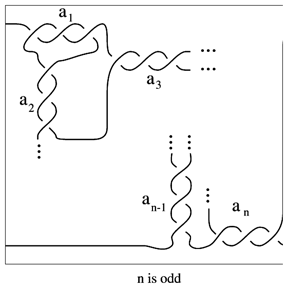
Figure: r130030a
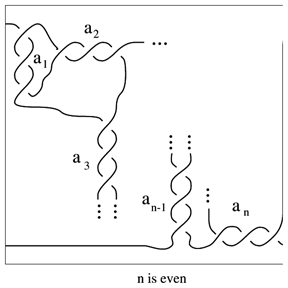
Figure: r130030b
Conway proved that two rational tangles are ambient isotopic (with boundary fixed) if and only if their slopes are equal. A rational $n$-tangle (also called an $n$-bridge $n$-tangle) is an $n$-tangle that can be obtained from the identity tangle by a finite number of additions of a single crossing.
References
- [a1] J.H. Conway, "An enumeration of knots and links" J. Leech (ed.) , Computational Problems in Abstract Algebra , Pergamon Press (1969) pp. 329–358 Zbl 0202.54703
- [a2] A. Kawauchi, "A survey of knot theory" , Birkhäuser (1996) Zbl 0861.57001
Rational tangles. Encyclopedia of Mathematics. URL: http://encyclopediaofmath.org/index.php?title=Rational_tangles&oldid=49883