Difference between revisions of "Saddle"
(Importing text file) |
Ulf Rehmann (talk | contribs) m (tex encoded by computer) |
||
| Line 1: | Line 1: | ||
| + | <!-- | ||
| + | s0830201.png | ||
| + | $#A+1 = 46 n = 0 | ||
| + | $#C+1 = 46 : ~/encyclopedia/old_files/data/S083/S.0803020 Saddle | ||
| + | Automatically converted into TeX, above some diagnostics. | ||
| + | Please remove this comment and the {{TEX|auto}} line below, | ||
| + | if TeX found to be correct. | ||
| + | --> | ||
| + | |||
| + | {{TEX|auto}} | ||
| + | {{TEX|done}} | ||
| + | |||
A type of arrangement of the trajectories of an [[Autonomous system|autonomous system]] of planar ordinary differential equations | A type of arrangement of the trajectories of an [[Autonomous system|autonomous system]] of planar ordinary differential equations | ||
| − | + | $$ \tag{* } | |
| + | \dot{x} = f ( x),\ \ | ||
| + | x \in \mathbf R ^ {2} ,\ \ | ||
| + | f: G \subset \mathbf R ^ {2} \rightarrow \mathbf R ^ {2} , | ||
| + | $$ | ||
| − | + | $ f \in C ( G) $, | |
| + | where $ G $ | ||
| + | is the domain of uniqueness, in a neighbourhood of a singular point ([[Equilibrium position|equilibrium position]]) $ x _ {0} $. | ||
| + | This type is characterized as follows. There is a neighbourhood $ U $ | ||
| + | of $ x _ {0} $ | ||
| + | such that for all trajectories of the system that start in $ U \setminus \{ x _ {0} \} $, | ||
| + | both the positive and negative semi-trajectories are diverging (as time passes they leave any compact set $ V \subset U $). | ||
| + | The exceptions are four trajectories, called the separatrices of the saddle. For two of these, the negative semi-trajectories are diverging and the positive semi-trajectories converge to $ x _ {0} $, | ||
| + | and for the other two the situation is just the opposite. The first two separatrices are called stable, and the second two, unstable. The stable separatrices, completed by $ x _ {0} $, | ||
| + | form a smooth curve through $ x _ {0} $— | ||
| + | the stable manifold of the saddle. The unstable separatrices, together with $ x _ {0} $, | ||
| + | form the smooth unstable manifold of the saddle. The point $ x _ {0} $ | ||
| + | is also called the saddle. | ||
| − | The saddle | + | The saddle $ x _ {0} $ |
| + | is unstable in the sense of Lyapunov (cf. [[Lyapunov stability|Lyapunov stability]]). Its Poincaré index is $ - 1 $( | ||
| + | cf. [[Singular point|Singular point]]). For a system (*) of class $ C ^ {1} $( | ||
| + | $ f \in C ^ {1} ( G) $) | ||
| + | with a non-zero matrix $ A = f ^ { \prime } ( x _ {0} ) $, | ||
| + | a stationary point $ x _ {0} $ | ||
| + | is a saddle when the eigenvalues $ \lambda _ {1} , \lambda _ {2} $ | ||
| + | of $ A $ | ||
| + | satisfy the condition $ \lambda _ {1} \lambda _ {2} < 0 $( | ||
| + | a simple saddle; see Fig. a, where $ x _ {0} = 0 $) | ||
| + | but it can also be a saddle when $ \lambda _ {1} = 0 \neq \lambda _ {2} $, | ||
| + | or $ \lambda _ {1} = \lambda _ {2} = 0 $. | ||
<img style="border:1px solid;" src="https://www.encyclopediaofmath.org/legacyimages/common_img/s083020a.gif" /> | <img style="border:1px solid;" src="https://www.encyclopediaofmath.org/legacyimages/common_img/s083020a.gif" /> | ||
| Line 11: | Line 50: | ||
Figure: s083020a | Figure: s083020a | ||
| − | In any of these cases the separatrices of the saddle are tangential at | + | In any of these cases the separatrices of the saddle are tangential at $ x _ {0} $ |
| + | to the directions defined by the eigenvectors of $ A $. | ||
| − | If the system (*) is linear ( | + | If the system (*) is linear ( $ f ( x) = A ( x - x _ {0} ) $, |
| + | where $ A $ | ||
| + | is a constant matrix with eigenvalues $ \lambda _ {1} $ | ||
| + | and $ \lambda _ {2} $), | ||
| + | then a point $ x _ {0} $ | ||
| + | of it is a saddle only when $ \lambda _ {1} \lambda _ {2} < 0 $. | ||
| + | In this case the separatrices of the saddle $ x _ {0} $ | ||
| + | are rectilinear, and all the other trajectories (distinct from $ x _ {0} $) | ||
| + | are affine images of the hyperbolas of the form $ x _ {2} = c | x _ {1} | ^ {\lambda _ {2} / \lambda _ {1} } $, | ||
| + | $ c \in \mathbf R \setminus \{ 0 \} $( | ||
| + | Fig. b). | ||
<img style="border:1px solid;" src="https://www.encyclopediaofmath.org/legacyimages/common_img/s083020b.gif" /> | <img style="border:1px solid;" src="https://www.encyclopediaofmath.org/legacyimages/common_img/s083020b.gif" /> | ||
| Line 19: | Line 69: | ||
Figure: s083020b | Figure: s083020b | ||
| − | The term "saddle" is also used for any of the arrangements of the trajectories of the system (*) in a neighbourhood | + | The term "saddle" is also used for any of the arrangements of the trajectories of the system (*) in a neighbourhood $ U $ |
| − | + | of an isolated stationary point $ x _ {0} $, | |
| − | + | where only a finite number $ m $( | |
| + | $ \geq 2 $) | ||
| + | of trajectories in $ U \setminus \{ 0 \} $ | ||
| + | approaches $ x _ {0} $ | ||
| + | and where each of them, completed by $ x _ {0} $, | ||
| + | touches at this point in a definite direction (an $ m $- | ||
| + | separatrix saddle). Certain types of stationary points of autonomous systems of ordinary differential equations of order $ n \geq 3 $ | ||
| + | are also called saddles. For references, see [[Singular point|Singular point]] of a differential equation. | ||
====Comments==== | ====Comments==== | ||
Cf. also [[Hyperbolic point|Hyperbolic point]] and [[Hyperbolic set|Hyperbolic set]] and the references given there. | Cf. also [[Hyperbolic point|Hyperbolic point]] and [[Hyperbolic set|Hyperbolic set]] and the references given there. | ||
Latest revision as of 08:12, 6 June 2020
A type of arrangement of the trajectories of an autonomous system of planar ordinary differential equations
$$ \tag{* } \dot{x} = f ( x),\ \ x \in \mathbf R ^ {2} ,\ \ f: G \subset \mathbf R ^ {2} \rightarrow \mathbf R ^ {2} , $$
$ f \in C ( G) $, where $ G $ is the domain of uniqueness, in a neighbourhood of a singular point (equilibrium position) $ x _ {0} $. This type is characterized as follows. There is a neighbourhood $ U $ of $ x _ {0} $ such that for all trajectories of the system that start in $ U \setminus \{ x _ {0} \} $, both the positive and negative semi-trajectories are diverging (as time passes they leave any compact set $ V \subset U $). The exceptions are four trajectories, called the separatrices of the saddle. For two of these, the negative semi-trajectories are diverging and the positive semi-trajectories converge to $ x _ {0} $, and for the other two the situation is just the opposite. The first two separatrices are called stable, and the second two, unstable. The stable separatrices, completed by $ x _ {0} $, form a smooth curve through $ x _ {0} $— the stable manifold of the saddle. The unstable separatrices, together with $ x _ {0} $, form the smooth unstable manifold of the saddle. The point $ x _ {0} $ is also called the saddle.
The saddle $ x _ {0} $ is unstable in the sense of Lyapunov (cf. Lyapunov stability). Its Poincaré index is $ - 1 $( cf. Singular point). For a system (*) of class $ C ^ {1} $( $ f \in C ^ {1} ( G) $) with a non-zero matrix $ A = f ^ { \prime } ( x _ {0} ) $, a stationary point $ x _ {0} $ is a saddle when the eigenvalues $ \lambda _ {1} , \lambda _ {2} $ of $ A $ satisfy the condition $ \lambda _ {1} \lambda _ {2} < 0 $( a simple saddle; see Fig. a, where $ x _ {0} = 0 $) but it can also be a saddle when $ \lambda _ {1} = 0 \neq \lambda _ {2} $, or $ \lambda _ {1} = \lambda _ {2} = 0 $.
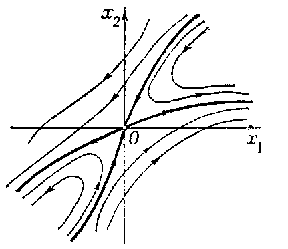
Figure: s083020a
In any of these cases the separatrices of the saddle are tangential at $ x _ {0} $ to the directions defined by the eigenvectors of $ A $.
If the system (*) is linear ( $ f ( x) = A ( x - x _ {0} ) $, where $ A $ is a constant matrix with eigenvalues $ \lambda _ {1} $ and $ \lambda _ {2} $), then a point $ x _ {0} $ of it is a saddle only when $ \lambda _ {1} \lambda _ {2} < 0 $. In this case the separatrices of the saddle $ x _ {0} $ are rectilinear, and all the other trajectories (distinct from $ x _ {0} $) are affine images of the hyperbolas of the form $ x _ {2} = c | x _ {1} | ^ {\lambda _ {2} / \lambda _ {1} } $, $ c \in \mathbf R \setminus \{ 0 \} $( Fig. b).
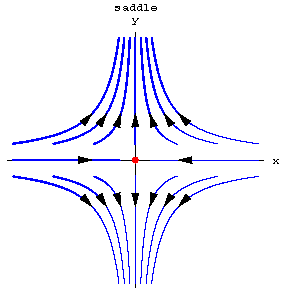
Figure: s083020b
The term "saddle" is also used for any of the arrangements of the trajectories of the system (*) in a neighbourhood $ U $ of an isolated stationary point $ x _ {0} $, where only a finite number $ m $( $ \geq 2 $) of trajectories in $ U \setminus \{ 0 \} $ approaches $ x _ {0} $ and where each of them, completed by $ x _ {0} $, touches at this point in a definite direction (an $ m $- separatrix saddle). Certain types of stationary points of autonomous systems of ordinary differential equations of order $ n \geq 3 $ are also called saddles. For references, see Singular point of a differential equation.
Comments
Cf. also Hyperbolic point and Hyperbolic set and the references given there.
Saddle. Encyclopedia of Mathematics. URL: http://encyclopediaofmath.org/index.php?title=Saddle&oldid=15481