Difference between revisions of "Parabolic coordinates"
(Importing text file) |
Ulf Rehmann (talk | contribs) m (tex encoded by computer) |
||
| Line 1: | Line 1: | ||
| − | + | <!-- | |
| + | p0711701.png | ||
| + | $#A+1 = 16 n = 0 | ||
| + | $#C+1 = 16 : ~/encyclopedia/old_files/data/P071/P.0701170 Parabolic coordinates | ||
| + | Automatically converted into TeX, above some diagnostics. | ||
| + | Please remove this comment and the {{TEX|auto}} line below, | ||
| + | if TeX found to be correct. | ||
| + | --> | ||
| − | + | {{TEX|auto}} | |
| + | {{TEX|done}} | ||
| − | where < | + | The numbers $ u $ |
| + | and $ v $ | ||
| + | related to rectangular Cartesian coordinates $ x $ | ||
| + | and $ y $ | ||
| + | by the formulas | ||
| + | |||
| + | $$ | ||
| + | x = u ^ {2} - v ^ {2} ,\ y = 2uv , | ||
| + | $$ | ||
| + | |||
| + | where $ - \infty < u < \infty $ | ||
| + | and $ 0 \leq v < \infty $. | ||
| + | The coordinate lines are two systems of mutually orthogonal parabolas with oppositely-directed axes. | ||
<img style="border:1px solid;" src="https://www.encyclopediaofmath.org/legacyimages/common_img/p071170a.gif" /> | <img style="border:1px solid;" src="https://www.encyclopediaofmath.org/legacyimages/common_img/p071170a.gif" /> | ||
| Line 11: | Line 31: | ||
The Lamé coefficients (or scale factors) are given by: | The Lamé coefficients (or scale factors) are given by: | ||
| − | + | $$ | |
| + | L _ {u} = L _ {v} = 2 \sqrt {u ^ {2} + v ^ {2} } . | ||
| + | $$ | ||
The area element is given by: | The area element is given by: | ||
| − | + | $$ | |
| + | d \sigma = 4( u ^ {2} + v ^ {2} ) du dv . | ||
| + | $$ | ||
The fundamental operators of vector analysis are given by: | The fundamental operators of vector analysis are given by: | ||
| − | + | $$ | |
| + | \mathop{\rm grad} _ {u} f = \ | ||
| − | + | \frac{1}{2 \sqrt {u ^ {2} + v ^ {2} } } | |
| + | |||
| + | \frac{\partial f }{\partial u } | ||
| + | , | ||
| + | $$ | ||
| − | + | $$ | |
| + | \mathop{\rm grad} _ {v} f = | ||
| + | \frac{1}{2 \sqrt {u ^ {2} | ||
| + | + v ^ {2} } } | ||
| + | |||
| + | \frac{\partial f }{\partial v } | ||
| + | , | ||
| + | $$ | ||
| − | + | $$ | |
| + | \mathop{\rm div} a = | ||
| + | \frac{1}{2 \sqrt {u ^ {2} + v ^ {2} } } | ||
| + | \left ( | ||
| + | \frac{\partial a _ {u} }{\partial u } | ||
| − | + | + | |
| + | \frac{\partial a _ {v} }{\partial v } | ||
| + | \right ) + | ||
| + | \frac{ua _ {u} + va _ {v} }{2 \sqrt {( u ^ {2} + v ^ {2} ) ^ {3} } } | ||
| + | , | ||
| + | $$ | ||
| + | $$ | ||
| + | \Delta f = | ||
| + | \frac{1}{4( u ^ {2} + v ^ {2} ) } | ||
| + | \left ( | ||
| + | \frac{\partial ^ {2} f }{ | ||
| + | \partial u ^ {2} } | ||
| + | + | ||
| + | \frac{\partial ^ {2} f }{\partial v ^ {2} } | ||
| + | \right ) . | ||
| + | $$ | ||
| + | In parabolic coordinates the [[Laplace equation|Laplace equation]] allows separation of variables. | ||
====Comments==== | ====Comments==== | ||
| − | Using complex functions the coordinate transformation can be described by | + | Using complex functions the coordinate transformation can be described by $ \widetilde{z} = z ^ {2} $, |
| + | where $ z= u+ iv $ | ||
| + | and $ \widetilde{z} = x+ iy $. | ||
For parabolic coordinates in space see [[#References|[a1]]]. | For parabolic coordinates in space see [[#References|[a1]]]. | ||
Latest revision as of 08:05, 6 June 2020
The numbers $ u $
and $ v $
related to rectangular Cartesian coordinates $ x $
and $ y $
by the formulas
$$ x = u ^ {2} - v ^ {2} ,\ y = 2uv , $$
where $ - \infty < u < \infty $ and $ 0 \leq v < \infty $. The coordinate lines are two systems of mutually orthogonal parabolas with oppositely-directed axes.
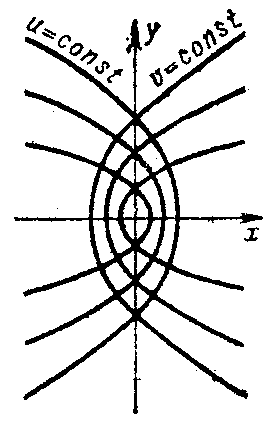
Figure: p071170a
The Lamé coefficients (or scale factors) are given by:
$$ L _ {u} = L _ {v} = 2 \sqrt {u ^ {2} + v ^ {2} } . $$
The area element is given by:
$$ d \sigma = 4( u ^ {2} + v ^ {2} ) du dv . $$
The fundamental operators of vector analysis are given by:
$$ \mathop{\rm grad} _ {u} f = \ \frac{1}{2 \sqrt {u ^ {2} + v ^ {2} } } \frac{\partial f }{\partial u } , $$
$$ \mathop{\rm grad} _ {v} f = \frac{1}{2 \sqrt {u ^ {2} + v ^ {2} } } \frac{\partial f }{\partial v } , $$
$$ \mathop{\rm div} a = \frac{1}{2 \sqrt {u ^ {2} + v ^ {2} } } \left ( \frac{\partial a _ {u} }{\partial u } + \frac{\partial a _ {v} }{\partial v } \right ) + \frac{ua _ {u} + va _ {v} }{2 \sqrt {( u ^ {2} + v ^ {2} ) ^ {3} } } , $$
$$ \Delta f = \frac{1}{4( u ^ {2} + v ^ {2} ) } \left ( \frac{\partial ^ {2} f }{ \partial u ^ {2} } + \frac{\partial ^ {2} f }{\partial v ^ {2} } \right ) . $$
In parabolic coordinates the Laplace equation allows separation of variables.
Comments
Using complex functions the coordinate transformation can be described by $ \widetilde{z} = z ^ {2} $, where $ z= u+ iv $ and $ \widetilde{z} = x+ iy $.
For parabolic coordinates in space see [a1].
References
| [a1] | R. Sauer (ed.) I. Szabó (ed.) , Mathematische Hilfsmittel des Ingenieurs , 1 , Springer (1967) pp. 98 |
| [a2] | L.D. Landau, E.M. Lifshits, "Mechanics" , Pergamon (1960) pp. 151ff (Translated from Russian) |
Parabolic coordinates. Encyclopedia of Mathematics. URL: http://encyclopediaofmath.org/index.php?title=Parabolic_coordinates&oldid=15697