|
|
| Line 1: |
Line 1: |
| − | ''at a point <img align="absmiddle" border="0" src="https://www.encyclopediaofmath.org/legacyimages/o/o070/o070560/o0705601.png" /> of a curve <img align="absmiddle" border="0" src="https://www.encyclopediaofmath.org/legacyimages/o/o070/o070560/o0705602.png" />'' | + | {{TEX|done}} |
| | + | ''at a point $M$ of a curve $l$'' |
| | | | |
| − | The plane having contact of order <img align="absmiddle" border="0" src="https://www.encyclopediaofmath.org/legacyimages/o/o070/o070560/o0705603.png" /> with <img align="absmiddle" border="0" src="https://www.encyclopediaofmath.org/legacyimages/o/o070/o070560/o0705604.png" /> at <img align="absmiddle" border="0" src="https://www.encyclopediaofmath.org/legacyimages/o/o070/o070560/o0705605.png" /> (see [[Osculation|Osculation]]). The osculating plane can also be defined as the limit of a variable plane passing through three points of <img align="absmiddle" border="0" src="https://www.encyclopediaofmath.org/legacyimages/o/o070/o070560/o0705606.png" /> as these points approach <img align="absmiddle" border="0" src="https://www.encyclopediaofmath.org/legacyimages/o/o070/o070560/o0705607.png" />. Usually, a curve intersects the osculating plane at the point of contact (see Fig.). | + | The plane having contact of order $n\geq2$ with $l$ at $M$ (see [[Osculation|Osculation]]). The osculating plane can also be defined as the limit of a variable plane passing through three points of $l$ as these points approach $M$. Usually, a curve intersects the osculating plane at the point of contact (see Fig.). |
| | | | |
| | <img style="border:1px solid;" src="https://www.encyclopediaofmath.org/legacyimages/common_img/o070560a.gif" /> | | <img style="border:1px solid;" src="https://www.encyclopediaofmath.org/legacyimages/common_img/o070560a.gif" /> |
| Line 7: |
Line 8: |
| | Figure: o070560a | | Figure: o070560a |
| | | | |
| − | If <img align="absmiddle" border="0" src="https://www.encyclopediaofmath.org/legacyimages/o/o070/o070560/o0705608.png" /> is given by equations | + | If $l$ is given by equations |
| | | | |
| − | <table class="eq" style="width:100%;"> <tr><td valign="top" style="width:94%;text-align:center;"><img align="absmiddle" border="0" src="https://www.encyclopediaofmath.org/legacyimages/o/o070/o070560/o0705609.png" /></td> </tr></table>
| + | $$x=x(u),\quad y=y(u),\quad z=z(u),$$ |
| | | | |
| | then the equation of the osculating plane has the form | | then the equation of the osculating plane has the form |
| | | | |
| − | <table class="eq" style="width:100%;"> <tr><td valign="top" style="width:94%;text-align:center;"><img align="absmiddle" border="0" src="https://www.encyclopediaofmath.org/legacyimages/o/o070/o070560/o07056010.png" /></td> </tr></table>
| + | $$\begin{vmatrix}X-x&Y-y&Z-z\\x'&y'&z'\\x''&y''&z''\end{vmatrix}=0,$$ |
| | | | |
| − | where <img align="absmiddle" border="0" src="https://www.encyclopediaofmath.org/legacyimages/o/o070/o070560/o07056011.png" /> are moving coordinates and <img align="absmiddle" border="0" src="https://www.encyclopediaofmath.org/legacyimages/o/o070/o070560/o07056012.png" />, <img align="absmiddle" border="0" src="https://www.encyclopediaofmath.org/legacyimages/o/o070/o070560/o07056013.png" />, <img align="absmiddle" border="0" src="https://www.encyclopediaofmath.org/legacyimages/o/o070/o070560/o07056014.png" /> are calculated at the point of contact. If all three coefficients of <img align="absmiddle" border="0" src="https://www.encyclopediaofmath.org/legacyimages/o/o070/o070560/o07056015.png" /> in the equation of the osculating plane vanish, then the osculating plane becomes indefinite (and can coincide with any plane through the tangent line). | + | where $X,Y,Z$ are moving coordinates and $x,y,z$, $x',y',z'$, $x'',y'',z''$ are calculated at the point of contact. If all three coefficients of $X,Y,Z$ in the equation of the osculating plane vanish, then the osculating plane becomes indefinite (and can coincide with any plane through the tangent line). |
| | | | |
| | | | |
Revision as of 08:50, 1 August 2014
at a point $M$ of a curve $l$
The plane having contact of order $n\geq2$ with $l$ at $M$ (see Osculation). The osculating plane can also be defined as the limit of a variable plane passing through three points of $l$ as these points approach $M$. Usually, a curve intersects the osculating plane at the point of contact (see Fig.).
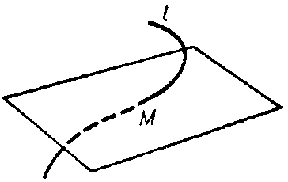
Figure: o070560a
If $l$ is given by equations
$$x=x(u),\quad y=y(u),\quad z=z(u),$$
then the equation of the osculating plane has the form
$$\begin{vmatrix}X-x&Y-y&Z-z\\x'&y'&z'\\x''&y''&z''\end{vmatrix}=0,$$
where $X,Y,Z$ are moving coordinates and $x,y,z$, $x',y',z'$, $x'',y'',z''$ are calculated at the point of contact. If all three coefficients of $X,Y,Z$ in the equation of the osculating plane vanish, then the osculating plane becomes indefinite (and can coincide with any plane through the tangent line).
References
| [a1] | R.S. Millman, G.D. Parker, "Elements of differential geometry" , Prentice-Hall (1977) pp. 31–35 |
| [a2] | D.J. Struik, "Lectures on classical differential geometry" , Dover, reprint (1988) pp. 10ff |
How to Cite This Entry:
Osculating plane. Encyclopedia of Mathematics. URL: http://encyclopediaofmath.org/index.php?title=Osculating_plane&oldid=12865
This article was adapted from an original article by BSE-3 (originator), which appeared in Encyclopedia of Mathematics - ISBN 1402006098.
See original article