Lebesgue integral
The most important generalization of the concept of an integral. Let  be a space with a non-negative complete countably-additive measure
  (cf. Countably-additive set function; Measure space), where
  . A simple function is a measurable function
  that takes at most a countable set of values:
  ,
,  for
for  , if
, if  ,
,  . A simple function
  is said to be summable if the series
 |
converges absolutely (cf. Absolutely convergent series); the sum of this series is the Lebesgue integral
 |
A function  is summable on
  ,
,  , if there is a sequence of simple summable functions
  uniformly convergent (cf. Uniform convergence) to
  on a set of full measure, and if the limit
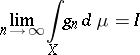 |
is finite. The number  is the Lebesgue integral
 |
This is well-defined: the limit  exists and does not depend on the choice of the sequence
  . If
. If  , then
  is a measurable almost-everywhere finite function on
  . The Lebesgue integral is a linear non-negative functional on
  with the following properties:
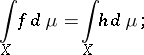
1) if  and if
 |
then  and
and
 |
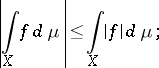
2) if  , then
  and
and
 |
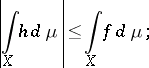
3) if  ,
,  and
and  is measurable, then
  and
and
 |
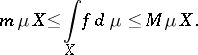
4) if  and
and  is measurable, then
  and
and
 |
In the case when  and
and  ,
,  , the Lebesgue integral is defined as
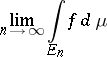 |
under the condition that this limit exists and is finite for any sequence  such that
  ,
,  ,
,  . In this case the properties 1), 2), 3) are preserved, but condition 4) is violated.
For the transition to the limit under the Lebesgue integral sign see Lebesgue theorem.
If  is a measurable set in
  , then the Lebesgue integral
 |
is defined either as above, by replacing  by
by  , or as
 |
where  is the characteristic function of
  ; these definitions are equivalent. If
  , then
  for any measurable
  . If
. If
 |
if  is measurable for every
  , if
, if
 |
and if  , then
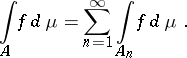 |
Conversely, if under these conditions on  one has
  for every
  and if
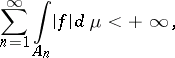 |
then  and the previous equality is true (
 -additivity of the Lebesgue integral).
The function of sets  given by
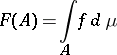 |
is absolutely continuous with respect to  (cf. Absolute continuity); if
  , then
  is a non-negative measure that is absolutely continuous with respect to
  . The converse assertion is the Radon–Nikodým theorem.
For functions  the name "Lebesgue integral" is applied to the corresponding functional if the measure
  is the Lebesgue measure; here, the set of summable functions is denoted simply by
  , and the integral by
 |
For other measures this functional is called a Lebesgue–Stieltjes integral.
If 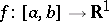 ,
,  and if
  is a non-decreasing absolutely continuous function, then
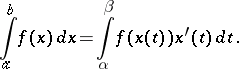 |
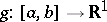
If 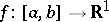 ,
,  and if
  is monotone on
  , then
  and there is a point
  such that
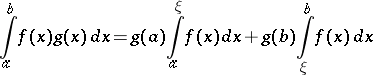 |
(the second mean-value theorem).
In 1902 H. Lebesgue gave (see [1]) a definition of the integral for  and measure
  equal to the Lebesgue measure. He constructed simple functions that uniformly approximate almost-everywhere on a set
  of finite measure a measurable non-negative function
  , and proved the existence of a common limit (finite or infinite) of the integrals of these simple functions as they tend to
  . The Lebesgue integral is a basis for various generalizations of the concept of an integral. As N.N. Luzin remarked [2], property 2), called absolute integrability, distinguishes the Lebesgue integral for
  from all possible generalized integrals.
References
| [1] | H. Lebesgue, "Leçons sur l'intégration et la récherche des fonctions primitives" , Gauthier-Villars (1928) |
| [2] | N.N. Luzin, "The integral and trigonometric series" , Moscow-Leningrad (1915) (In Russian) (Thesis; also: Collected Works, Vol. 1, Moscow, 1953, pp. 48–212) |
| [3] | A.N. Kolmogorov, S.V. Fomin, "Elements of the theory of functions and functional analysis" , 1–2 , Graylock (1957–1961) (Translated from Russian) |
Comments
For other generalizations of the notion of an integral see  -integral; Bochner integral; Boks integral; Burkill integral; Daniell integral; Darboux sum; Denjoy integral; Kolmogorov integral; Perron integral; Perron–Stieltjes integral; Pettis integral; Radon integral; Stieltjes integral; Strong integral; Wiener integral. See also, of course, Riemann integral. See also Double integral; Improper integral; Fubini theorem (on changing the order of integration).
References
| [a1] | P.R. Halmos, "Measure theory" , v. Nostrand (1950) |
| [a2] | I.N. Pesin, "Classical and modern integration theories" , Acad. Press (1970) (Translated from Russian) |
| [a3] | S. Saks, "Theory of the integral" , Hafner (1952) (Translated from French) |
| [a4] | H.L. Royden, "Real analysis" , Macmillan (1968) |
| [a5] | W. Rudin, "Real and complex analysis" , McGraw-Hill (1978) pp. 24 |
| [a6] | E. Hewitt, K.R. Stromberg, "Real and abstract analysis" , Springer (1965) |
Lebesgue integral. Encyclopedia of Mathematics. URL: http://encyclopediaofmath.org/index.php?title=Lebesgue_integral&oldid=18585