Spectral theory of compact operators
From Encyclopedia of Mathematics
The printable version is no longer supported and may have rendering errors. Please update your browser bookmarks and please use the default browser print function instead.
Riesz theory of compact operators
Let  be a complex Banach space and
  a compact operator on
  . Then
  , the spectrum of
  , is countable and has no cluster points except, possibly,
  . Every
  is an eigenvalue, and a pole of the resolvent function
  . Let
. Let  be the order of the pole
  . For each
  ,
,  is closed, and this range is constant for
  . The null space
  is finite dimensional and constant for
  . The spectral projection
  (the Riesz projector, see Riesz decomposition theorem) has non-zero finite-dimensional range, equal to
  , and its null space is
 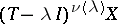 . Finally,
  .
.
The respective integers  and
and  are called the index and the algebraic multiplicity of the eigenvalue
  .
.
References
| [a1] | H.R. Dowson, "Spectral theory of linear operators" , Acad. Press (1978) pp. 45ff. |
| [a2] | N. Dunford, J.T. Schwartz, "Linear operators I: General theory" , Interscience (1964) pp. Sect. VII.4 |
How to Cite This Entry:
Spectral theory of compact operators. Encyclopedia of Mathematics. URL: http://encyclopediaofmath.org/index.php?title=Spectral_theory_of_compact_operators&oldid=18215
Spectral theory of compact operators. Encyclopedia of Mathematics. URL: http://encyclopediaofmath.org/index.php?title=Spectral_theory_of_compact_operators&oldid=18215
This article was adapted from an original article by M. Hazewinkel (originator), which appeared in Encyclopedia of Mathematics - ISBN 1402006098. See original article