H^infinity-control-theory
A branch of control theory where the performance of a dynamical system (cf. Automatic control theory) is appraised in terms of the  -norm. The Banach space
  (named after G.H. Hardy, cf. Hardy classes) consists of all complex-valued functions of a complex variable which are analytic and of bounded modulus in the open right half-plane. The norm of such a function is the supremum modulus:
 |
By a theorem of Fatou (cf. Fatou theorem), such a function has a boundary value  for almost-all
  , and, moreover,
 |
The theory of  control was initiated by G. Zames [a1], [a2], [a3], who formulated a basic feedback problem as an optimization problem with an operator norm, in particular, an
  -norm. Relevant contemporaneous works are those of J.W. Helton [a4] and A. Tannenbaum [a5].
The theory treats dynamical systems represented as integral operators of the form
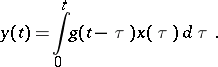 |
Here  is sufficiently regular to make the input-output mapping
  a bounded operator on
  . Taking Laplace transforms gives
  . The function
  is called the transfer function of the system and it belongs to
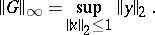
  because the integral operator is bounded. Moreover, the
  -norm of
  equals the norm of the integral operator, i.e.,
 | (a1) |
There are two prototype problems giving rise to an optimality criterion with the  -norm. The first is the problem of robust stability of the feedback system
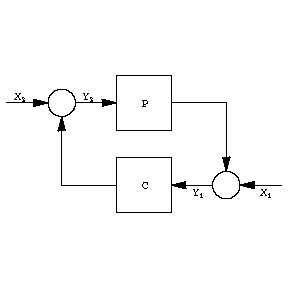
Figure: h046020a
Here  and
and  are transfer functions in
  , and
, and  ,
,  ,
,  ,
,  are Laplace transforms of signals;
  represents a "plant" , the dynamical system which is to be controlled, and
  represents the "controller" (cf. also Automatic control theory). The figure stands for the two equations
 |
which can be solved to give
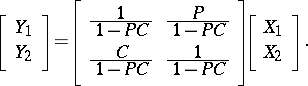 |
Therefore, the input-output mapping for the feedback system has four transfer functions. The feedback system is said to be internally stable if these four transfer functions are all in  . A simple sufficient condition for this is
  .
.
Internal stability is robust if it is preserved under perturbation of  . There are several possible notions of perturbation, typical of which is additive perturbation. So suppose
  is perturbed to
  , with
  in
in  . About
  it is assumed that only a bound on
  is known, namely,
 |
where  . J.C. Doyle and G. Stein [a6] showed that internal stability is preserved under all such perturbations if and only if
 | (a2) |
This leads to the robust stability design problem: Given  and
and  , find
  so that the feedback system is internally stable and (a2) holds.
The second problem relates to the same feedback system. Suppose  ,
,  represents a disturbance signal, and the objective is to reduce the effect of
  on the output
  . The transfer function from
  to
to  equals
  . Suppose, in addition, that the disturbance is not a fixed signal, but can be the output of another system with any input in
  of unit norm; let this latter system have transfer function
  in
in  . Then, in view of (a1), the supremal
  -norm of
  over all such disturbances equals
  . This leads to the disturbance attenuation problem: Given
  and
and  , find
  to achieve internal stability and minimize
  .
.
The above two problems are special cases of the more general standard  control problem. It can be solved by reduction to the Nehari problem of approximating a function in
  (bounded functions on the imaginary axis) by one in
  . A summary of this theory is in [a7], and a detailed treatment is in [a8].
References
| [a1] | G. Zames, "Feedback and complexity, Special plenary lecture addendum" , IEEE Conf. Decision Control , IEEE (1976) |
| [a2] | G. Zames, "Optimal sensitivity and feedback: weighted seminorms, approximate inverses, and plant invariant schemes" , Proc. Allerton Conf. , IEEE (1979) |
| [a3] | G. Zames, "Feedback and optimal sensitivity: model reference transformations, multiplicative seminorms, and approximate inverses" IEEE Trans. Auto. Control , AC-26 (1981) pp. 301–320 |
| [a4] | J.W. Helton, "Operator theory and broadband matching" , Proc. Allerton Conf. , IEEE (1979) |
| [a5] | A. Tannenbaum, "On the blending problem and parameter uncertainty in control theory" Techn. Report Dept. Math. Weizmann Institute (1977) |
| [a6] | J.C. Doyle, G. Stein, "Multivariable feedback design: concepts for a classical modern synthesis" IEEE Trans. Auto. Control , AC-26 (1981) pp. 4–16 |
| [a7] | B.A. Francis, J.C. Doyle, "Linear control theory with an  optimality criterion" SIAM J. Control and Opt. , 25 (1987) pp. 815–844 optimality criterion" SIAM J. Control and Opt. , 25 (1987) pp. 815–844 |
| [a8] | B.A. Francis, "A course in  control theory" , Lect. notes in control and inform. science , 88 , Springer (1987) control theory" , Lect. notes in control and inform. science , 88 , Springer (1987) |
H^infinity-control-theory. Encyclopedia of Mathematics. URL: http://encyclopediaofmath.org/index.php?title=H%5Einfinity-control-theory&oldid=15222