Sum function of a function

The function of  that denotes the sum of the values
  of the function
  on the set of natural numbers
  ,
,  . Sum functions are one of the basic means of expressing various properties of sequences of numbers.
Examples of sum functions: the number of prime numbers  ;
;  — the Chebyshev function; the number of divisors of all
  , etc. (see [1], [2]).
The basic problem is to find as accurate as possible an expression of the sum function, and for a sum function which does not have asymptotics, to find the best estimate of its modulus for large values of  .
.
The Cauchy integral theorem and Dirichlet series of the form
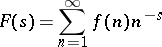 |
form the basis of the analytic methods of studying sum functions. If such a series converges absolutely for  , then for a non-integer
  , and
, and  , the identity
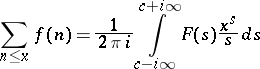 |
holds; a corresponding estimate of the sum function of  is obtained from this by analytic continuation of
  by shifting the integration path to the left to a certain
  and estimating the integral along the new path. If
  , for example, the integration can be shifted to
  , which gives the Riemann–von Mangoldt formula for
  . Of the common applications of the method, the following theorem is known.
Assumptions:
 ,
,  are complex numbers,
  ,
,  ,
,  are real numbers,
  ,
,  are positive numbers,
  and
and  are integers
  ,
,  is the gamma-function, and
  .
.
1) For any  ,
,  ;
;
2) the function
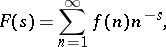 |
defined for  ,
,  , is meromorphic in the whole plane, and has a finite number of poles in the strip
  ;
;
3) the series  converges absolutely when
  ;
;
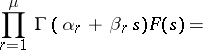
4) for  ,
,
 |
 |
5)  ;
;
6) if one assumes that
 |
then  .
.
For a fixed strip  there is a constant
  such that for
  and large
  the estimate
  holds.
Conclusion.
For any  ,
,
 |
where  is the sum of the residues of the function
  over all its poles in the strip
 |
References
| [1] | E.C. Titchmarsh, "The theory of the Riemann zeta-function" , Clarendon Press (1951) |
| [2] | L.-K. Hua, "Abschätzungen von Exponentialsummen und ihre Anwendung in der Zahlentheorie" , Enzyklopaedie der Mathematischen Wissenschaften mit Einschluss ihrer Anwendungen , 1 : 2 (1959) (Heft 13, Teil 1) |
Comments
The Riemann–von Mangoldt formula, or von Mangoldt formula, for  ,
,  , is
, is
 |
This is von Mangoldt's reformulation of Riemann's main formula
 |
where  , the
, the  -function is
 |
and  is the logarithmic integral
 |
References
| [a1] | H.M. Edwards, "Riemann's zeta function" , Acad. Press (1974) pp. Chapt. 3 |
Sum function of a function. Encyclopedia of Mathematics. URL: http://encyclopediaofmath.org/index.php?title=Sum_function_of_a_function&oldid=13296