Difference between revisions of "Multinomial distribution"
Ulf Rehmann (talk | contribs) m (tex encoded by computer) |
Ulf Rehmann (talk | contribs) m (Undo revision 47928 by Ulf Rehmann (talk)) Tag: Undo |
||
| Line 1: | Line 1: | ||
| − | |||
| − | |||
| − | |||
| − | |||
| − | |||
| − | |||
| − | |||
| − | |||
| − | |||
| − | |||
| − | |||
| − | |||
''polynomial distribution'' | ''polynomial distribution'' | ||
| Line 17: | Line 5: | ||
[[Category:Distribution theory]] | [[Category:Distribution theory]] | ||
| − | The joint distribution of random variables | + | The joint distribution of random variables <img align="absmiddle" border="0" src="https://www.encyclopediaofmath.org/legacyimages/m/m065/m065330/m0653301.png" /> that is defined for any set of non-negative integers <img align="absmiddle" border="0" src="https://www.encyclopediaofmath.org/legacyimages/m/m065/m065330/m0653302.png" /> satisfying the condition <img align="absmiddle" border="0" src="https://www.encyclopediaofmath.org/legacyimages/m/m065/m065330/m0653303.png" />, <img align="absmiddle" border="0" src="https://www.encyclopediaofmath.org/legacyimages/m/m065/m065330/m0653304.png" />, <img align="absmiddle" border="0" src="https://www.encyclopediaofmath.org/legacyimages/m/m065/m065330/m0653305.png" />, by the formula |
| − | that is defined for any set of non-negative integers | ||
| − | satisfying the condition | ||
| − | |||
| − | |||
| − | by the formula | ||
| − | + | <table class="eq" style="width:100%;"> <tr><td valign="top" style="width:94%;text-align:center;"><img align="absmiddle" border="0" src="https://www.encyclopediaofmath.org/legacyimages/m/m065/m065330/m0653306.png" /></td> <td valign="top" style="width:5%;text-align:right;">(*)</td></tr></table> | |
| − | |||
| − | |||
| − | |||
| − | where | + | where <img align="absmiddle" border="0" src="https://www.encyclopediaofmath.org/legacyimages/m/m065/m065330/m0653307.png" /> (<img align="absmiddle" border="0" src="https://www.encyclopediaofmath.org/legacyimages/m/m065/m065330/m0653308.png" />, <img align="absmiddle" border="0" src="https://www.encyclopediaofmath.org/legacyimages/m/m065/m065330/m0653309.png" />) are the parameters of the distribution. A multinomial distribution is a multivariate discrete distribution, namely the distribution for the random vector <img align="absmiddle" border="0" src="https://www.encyclopediaofmath.org/legacyimages/m/m065/m065330/m06533010.png" /> with <img align="absmiddle" border="0" src="https://www.encyclopediaofmath.org/legacyimages/m/m065/m065330/m06533011.png" /> (this distribution is in essence <img align="absmiddle" border="0" src="https://www.encyclopediaofmath.org/legacyimages/m/m065/m065330/m06533012.png" />-dimensional, since it is degenerate in the Euclidean space of <img align="absmiddle" border="0" src="https://www.encyclopediaofmath.org/legacyimages/m/m065/m065330/m06533013.png" /> dimensions). A multinomial distribution is a natural generalization of a [[Binomial distribution|binomial distribution]] and coincides with the latter for <img align="absmiddle" border="0" src="https://www.encyclopediaofmath.org/legacyimages/m/m065/m065330/m06533014.png" />. The name of the distribution is given because the probability (*) is the general term in the expansion of the multinomial <img align="absmiddle" border="0" src="https://www.encyclopediaofmath.org/legacyimages/m/m065/m065330/m06533015.png" />. The multinomial distribution appears in the following probability scheme. Each of the random variables <img align="absmiddle" border="0" src="https://www.encyclopediaofmath.org/legacyimages/m/m065/m065330/m06533016.png" /> is the number of occurrences of one of the mutually exclusive events <img align="absmiddle" border="0" src="https://www.encyclopediaofmath.org/legacyimages/m/m065/m065330/m06533017.png" />, <img align="absmiddle" border="0" src="https://www.encyclopediaofmath.org/legacyimages/m/m065/m065330/m06533018.png" />, in repeated independent trials. If in each trial the probability of event <img align="absmiddle" border="0" src="https://www.encyclopediaofmath.org/legacyimages/m/m065/m065330/m06533019.png" /> is <img align="absmiddle" border="0" src="https://www.encyclopediaofmath.org/legacyimages/m/m065/m065330/m06533020.png" />, <img align="absmiddle" border="0" src="https://www.encyclopediaofmath.org/legacyimages/m/m065/m065330/m06533021.png" />, then the probability (*) is equal to the probability that in <img align="absmiddle" border="0" src="https://www.encyclopediaofmath.org/legacyimages/m/m065/m065330/m06533022.png" /> trials the events <img align="absmiddle" border="0" src="https://www.encyclopediaofmath.org/legacyimages/m/m065/m065330/m06533023.png" /> will appear <img align="absmiddle" border="0" src="https://www.encyclopediaofmath.org/legacyimages/m/m065/m065330/m06533024.png" /> times, respectively. Each of the random variables <img align="absmiddle" border="0" src="https://www.encyclopediaofmath.org/legacyimages/m/m065/m065330/m06533025.png" /> has a binomial distribution with mathematical expectation <img align="absmiddle" border="0" src="https://www.encyclopediaofmath.org/legacyimages/m/m065/m065330/m06533026.png" /> and variance <img align="absmiddle" border="0" src="https://www.encyclopediaofmath.org/legacyimages/m/m065/m065330/m06533027.png" />. |
| − | |||
| − | |||
| − | are the parameters of the distribution. A multinomial distribution is a multivariate discrete distribution, namely the distribution for the random vector | ||
| − | with | ||
| − | this distribution is in essence | ||
| − | dimensional, since it is degenerate in the Euclidean space of | ||
| − | dimensions). A multinomial distribution is a natural generalization of a [[Binomial distribution|binomial distribution]] and coincides with the latter for | ||
| − | The name of the distribution is given because the probability (*) is the general term in the expansion of the multinomial | ||
| − | The multinomial distribution appears in the following probability scheme. Each of the random variables | ||
| − | is the number of occurrences of one of the mutually exclusive events | ||
| − | |||
| − | in repeated independent trials. If in each trial the probability of event | ||
| − | is | ||
| − | |||
| − | then the probability (*) is equal to the probability that in | ||
| − | trials the events | ||
| − | will appear | ||
| − | times, respectively. Each of the random variables | ||
| − | has a binomial distribution with mathematical expectation | ||
| − | and variance | ||
| − | The random vector | + | The random vector <img align="absmiddle" border="0" src="https://www.encyclopediaofmath.org/legacyimages/m/m065/m065330/m06533028.png" /> has mathematical expectation <img align="absmiddle" border="0" src="https://www.encyclopediaofmath.org/legacyimages/m/m065/m065330/m06533029.png" /> and covariance matrix <img align="absmiddle" border="0" src="https://www.encyclopediaofmath.org/legacyimages/m/m065/m065330/m06533030.png" />, where |
| − | has mathematical expectation | ||
| − | and covariance matrix | ||
| − | where | ||
| − | + | <table class="eq" style="width:100%;"> <tr><td valign="top" style="width:94%;text-align:center;"><img align="absmiddle" border="0" src="https://www.encyclopediaofmath.org/legacyimages/m/m065/m065330/m06533031.png" /></td> </tr></table> | |
| − | |||
| − | (the rank of the matrix | + | (the rank of the matrix <img align="absmiddle" border="0" src="https://www.encyclopediaofmath.org/legacyimages/m/m065/m065330/m06533032.png" /> is <img align="absmiddle" border="0" src="https://www.encyclopediaofmath.org/legacyimages/m/m065/m065330/m06533033.png" /> because <img align="absmiddle" border="0" src="https://www.encyclopediaofmath.org/legacyimages/m/m065/m065330/m06533034.png" />). The characteristic function of a multinomial distribution is |
| − | is | ||
| − | because | ||
| − | The characteristic function of a multinomial distribution is | ||
| − | + | <table class="eq" style="width:100%;"> <tr><td valign="top" style="width:94%;text-align:center;"><img align="absmiddle" border="0" src="https://www.encyclopediaofmath.org/legacyimages/m/m065/m065330/m06533035.png" /></td> </tr></table> | |
| − | |||
| − | |||
| − | For | + | For <img align="absmiddle" border="0" src="https://www.encyclopediaofmath.org/legacyimages/m/m065/m065330/m06533036.png" />, the distribution of the vector <img align="absmiddle" border="0" src="https://www.encyclopediaofmath.org/legacyimages/m/m065/m065330/m06533037.png" /> with normalized components |
| − | the distribution of the vector | ||
| − | with normalized components | ||
| − | + | <table class="eq" style="width:100%;"> <tr><td valign="top" style="width:94%;text-align:center;"><img align="absmiddle" border="0" src="https://www.encyclopediaofmath.org/legacyimages/m/m065/m065330/m06533038.png" /></td> </tr></table> | |
| − | |||
| − | |||
| − | |||
| − | |||
| − | |||
tends to a certain multivariate [[Normal distribution|normal distribution]], while the distribution of the sum | tends to a certain multivariate [[Normal distribution|normal distribution]], while the distribution of the sum | ||
| − | + | <table class="eq" style="width:100%;"> <tr><td valign="top" style="width:94%;text-align:center;"><img align="absmiddle" border="0" src="https://www.encyclopediaofmath.org/legacyimages/m/m065/m065330/m06533039.png" /></td> </tr></table> | |
| − | |||
| − | |||
| − | (which is used in mathematical statistics to construct the [[Chi-squared distribution| "chi-squared" test]]) tends to the [[Chi-squared test| "chi-squared" distribution]] with | + | (which is used in mathematical statistics to construct the [[Chi-squared distribution| "chi-squared" test]]) tends to the [[Chi-squared test| "chi-squared" distribution]] with <img align="absmiddle" border="0" src="https://www.encyclopediaofmath.org/legacyimages/m/m065/m065330/m06533040.png" /> degrees of freedom. |
| − | degrees of freedom. | ||
====References==== | ====References==== | ||
| Line 94: | Line 35: | ||
====Comments==== | ====Comments==== | ||
| + | |||
====References==== | ====References==== | ||
Revision as of 14:32, 7 June 2020
polynomial distribution
2020 Mathematics Subject Classification: Primary: 60E99 [MSN][ZBL]
The joint distribution of random variables  that is defined for any set of non-negative integers
  satisfying the condition
  ,
,  ,
,  , by the formula
 | (*) |
where  (
( ,
,  ) are the parameters of the distribution. A multinomial distribution is a multivariate discrete distribution, namely the distribution for the random vector
  with
with  (this distribution is in essence
  -dimensional, since it is degenerate in the Euclidean space of
  dimensions). A multinomial distribution is a natural generalization of a binomial distribution and coincides with the latter for
  . The name of the distribution is given because the probability (*) is the general term in the expansion of the multinomial
  . The multinomial distribution appears in the following probability scheme. Each of the random variables
  is the number of occurrences of one of the mutually exclusive events
  ,
,  , in repeated independent trials. If in each trial the probability of event
  is
is  ,
,  , then the probability (*) is equal to the probability that in
  trials the events
  will appear
  times, respectively. Each of the random variables
  has a binomial distribution with mathematical expectation
  and variance
  .
.
The random vector  has mathematical expectation
  and covariance matrix
  , where
 |
(the rank of the matrix  is
is  because
  ). The characteristic function of a multinomial distribution is
 |
For  , the distribution of the vector
  with normalized components
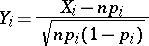 |
tends to a certain multivariate normal distribution, while the distribution of the sum
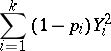 |
(which is used in mathematical statistics to construct the "chi-squared" test) tends to the "chi-squared" distribution with  degrees of freedom.
References
| [C] | H. Cramér, "Mathematical methods of statistics" , Princeton Univ. Press (1946) MR0016588 Zbl 0063.01014 |
Comments
References
| [JK] | N.L. Johnson, S. Kotz, "Discrete distributions" , Wiley (1969) MR0268996 Zbl 0292.62009 |
Multinomial distribution. Encyclopedia of Mathematics. URL: http://encyclopediaofmath.org/index.php?title=Multinomial_distribution&oldid=49316