Difference between revisions of "Cartesian-closed category"
(Importing text file) |
m (link) |
||
| Line 1: | Line 1: | ||
A [[Category|category]] <img align="absmiddle" border="0" src="https://www.encyclopediaofmath.org/legacyimages/c/c130/c130030/c1300301.png" /> such that the following axioms are satisfied: | A [[Category|category]] <img align="absmiddle" border="0" src="https://www.encyclopediaofmath.org/legacyimages/c/c130/c130030/c1300301.png" /> such that the following axioms are satisfied: | ||
| − | A1) there exists a terminal object <img align="absmiddle" border="0" src="https://www.encyclopediaofmath.org/legacyimages/c/c130/c130030/c1300302.png" />; | + | A1) there exists a [[terminal object]] <img align="absmiddle" border="0" src="https://www.encyclopediaofmath.org/legacyimages/c/c130/c130030/c1300302.png" />; |
A2) for any pair <img align="absmiddle" border="0" src="https://www.encyclopediaofmath.org/legacyimages/c/c130/c130030/c1300303.png" />, <img align="absmiddle" border="0" src="https://www.encyclopediaofmath.org/legacyimages/c/c130/c130030/c1300304.png" /> of objects of <img align="absmiddle" border="0" src="https://www.encyclopediaofmath.org/legacyimages/c/c130/c130030/c1300305.png" /> there exist a product <img align="absmiddle" border="0" src="https://www.encyclopediaofmath.org/legacyimages/c/c130/c130030/c1300306.png" /> and given projections <img align="absmiddle" border="0" src="https://www.encyclopediaofmath.org/legacyimages/c/c130/c130030/c1300307.png" />, <img align="absmiddle" border="0" src="https://www.encyclopediaofmath.org/legacyimages/c/c130/c130030/c1300308.png" />; | A2) for any pair <img align="absmiddle" border="0" src="https://www.encyclopediaofmath.org/legacyimages/c/c130/c130030/c1300303.png" />, <img align="absmiddle" border="0" src="https://www.encyclopediaofmath.org/legacyimages/c/c130/c130030/c1300304.png" /> of objects of <img align="absmiddle" border="0" src="https://www.encyclopediaofmath.org/legacyimages/c/c130/c130030/c1300305.png" /> there exist a product <img align="absmiddle" border="0" src="https://www.encyclopediaofmath.org/legacyimages/c/c130/c130030/c1300306.png" /> and given projections <img align="absmiddle" border="0" src="https://www.encyclopediaofmath.org/legacyimages/c/c130/c130030/c1300307.png" />, <img align="absmiddle" border="0" src="https://www.encyclopediaofmath.org/legacyimages/c/c130/c130030/c1300308.png" />; | ||
Revision as of 21:00, 21 December 2017
A category  such that the following axioms are satisfied:
A1) there exists a terminal object  ;
;
A2) for any pair  ,
,  of objects of
  there exist a product
  and given projections
  ,
,  ;
;
A3) for any pair  ,
,  of objects of
  there exist an object
  and an evaluation arrow
  such that for any arrow
  there is a unique arrow
 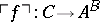 with
with  .
.
These conditions are equivalent to the following:  is a category with given products such that the functors
 |
 |
have each a specified right-adjoint, written respectively as:
 |
 |
Some examples of Cartesian-closed categories are:
E1) any Heyting algebra  ;
;
E2) the category  for any small category
  with
with  the category of (small) sets — in particular
  itself;
E3) the category of sheaves over a topological space, and more generally a (Grothendieck) topos;
E4) any elementary topos  ;
;
E5) the category  of all (small) categories;
E6) the category  of graphs and their homomorphisms;
E7) the category  -
- of
of  -CPOs.
These definitions can all be put into a purely equational form.
References
| [a1] | M. Barr, C. Wells, "Category theory for computing science" , CRM (1990) |
| [a2] | J. Lambek, P.J. Scott, "Introduction to higher order categorical logic" , Cambridge Univ. Press (1986) |
| [a3] | S. MacLane, I. Moerdijk, "Sheaves in geometry and logic" , Springer (1992) |
| [a4] | S. MacLane, "Categories for the working mathematician" , Springer (1971) |
Cartesian-closed category. Encyclopedia of Mathematics. URL: http://encyclopediaofmath.org/index.php?title=Cartesian-closed_category&oldid=14645