Difference between revisions of "Structure(2)"
Ulf Rehmann (talk | contribs) m (tex encoded by computer) |
Ulf Rehmann (talk | contribs) m (Undo revision 48881 by Ulf Rehmann (talk)) Tag: Undo |
||
| Line 1: | Line 1: | ||
| − | |||
| − | |||
| − | |||
| − | |||
| − | |||
| − | |||
| − | |||
| − | |||
| − | |||
| − | |||
| − | |||
| − | |||
Also called mathematical structure. A generic name for unifying concepts whose general characteristic is that they can be applied to sets whose elements are of an indefinite nature. In order to define a structure, relations are given in which the elements of the set appear (the type characteristic of a structure), and it is then postulated that these relations satisfy certain conditions — axioms of the structure. | Also called mathematical structure. A generic name for unifying concepts whose general characteristic is that they can be applied to sets whose elements are of an indefinite nature. In order to define a structure, relations are given in which the elements of the set appear (the type characteristic of a structure), and it is then postulated that these relations satisfy certain conditions — axioms of the structure. | ||
====References==== | ====References==== | ||
<table><TR><TD valign="top">[1]</TD> <TD valign="top"> N. Bourbaki, "Eléments d'histoire des mathématiques" , Hermann (1960)</TD></TR><TR><TD valign="top">[2]</TD> <TD valign="top"> N. Bourbaki, "Elements of mathematics. Theory of sets" , Addison-Wesley (1968) (Translated from French)</TD></TR></table> | <table><TR><TD valign="top">[1]</TD> <TD valign="top"> N. Bourbaki, "Eléments d'histoire des mathématiques" , Hermann (1960)</TD></TR><TR><TD valign="top">[2]</TD> <TD valign="top"> N. Bourbaki, "Elements of mathematics. Theory of sets" , Addison-Wesley (1968) (Translated from French)</TD></TR></table> | ||
| + | |||
| + | |||
====Comments==== | ====Comments==== | ||
| − | Sets endowed with a given structure plus mappings of sets which preserve this structure together form a [[Category|category]]. Such categories are called concrete (cf. also [[Category|Category]]; [[Sets, category of|Sets, category of]]). More precisely, a concrete category is a pair | + | Sets endowed with a given structure plus mappings of sets which preserve this structure together form a [[Category|category]]. Such categories are called concrete (cf. also [[Category|Category]]; [[Sets, category of|Sets, category of]]). More precisely, a concrete category is a pair <img align="absmiddle" border="0" src="https://www.encyclopediaofmath.org/legacyimages/s/s090/s090670/s0906701.png" /> consisting of a category <img align="absmiddle" border="0" src="https://www.encyclopediaofmath.org/legacyimages/s/s090/s090670/s0906702.png" /> and a faithful functor <img align="absmiddle" border="0" src="https://www.encyclopediaofmath.org/legacyimages/s/s090/s090670/s0906703.png" />. Because <img align="absmiddle" border="0" src="https://www.encyclopediaofmath.org/legacyimages/s/s090/s090670/s0906704.png" /> is faithful, <img align="absmiddle" border="0" src="https://www.encyclopediaofmath.org/legacyimages/s/s090/s090670/s0906705.png" /> can be identified with <img align="absmiddle" border="0" src="https://www.encyclopediaofmath.org/legacyimages/s/s090/s090670/s0906706.png" />, and an object <img align="absmiddle" border="0" src="https://www.encyclopediaofmath.org/legacyimages/s/s090/s090670/s0906707.png" /> of a concrete category is a set <img align="absmiddle" border="0" src="https://www.encyclopediaofmath.org/legacyimages/s/s090/s090670/s0906708.png" /> with extra structure while a morphism <img align="absmiddle" border="0" src="https://www.encyclopediaofmath.org/legacyimages/s/s090/s090670/s0906709.png" /> is an actual mapping of sets that preserves the extra structure; composition of morphisms is accomplished by the usual composition of mappings of sets. Often the set of morphisms <img align="absmiddle" border="0" src="https://www.encyclopediaofmath.org/legacyimages/s/s090/s090670/s09067010.png" /> consists of all structure-preserving mappings of sets, but this need not be the case. |
| − | consisting of a category | ||
| − | and a faithful functor | ||
| − | Because | ||
| − | is faithful, | ||
| − | can be identified with | ||
| − | and an object | ||
| − | of a concrete category is a set | ||
| − | with extra structure while a morphism | ||
| − | is an actual mapping of sets that preserves the extra structure; composition of morphisms is accomplished by the usual composition of mappings of sets. Often the set of morphisms | ||
| − | consists of all structure-preserving mappings of sets, but this need not be the case. | ||
A category is concrete if and only if it satisfies the Isbell condition (the Freyd concreteness theorem). Here, the Isbell condition is the following. A span in a category is a diagram of the form | A category is concrete if and only if it satisfies the Isbell condition (the Freyd concreteness theorem). Here, the Isbell condition is the following. A span in a category is a diagram of the form | ||
| − | + | <table class="eq" style="width:100%;"> <tr><td valign="top" style="width:94%;text-align:center;"><img align="absmiddle" border="0" src="https://www.encyclopediaofmath.org/legacyimages/s/s090/s090670/s09067011.png" /></td> </tr></table> | |
| − | Two | + | Two <img align="absmiddle" border="0" src="https://www.encyclopediaofmath.org/legacyimages/s/s090/s090670/s09067012.png" />-spans <img align="absmiddle" border="0" src="https://www.encyclopediaofmath.org/legacyimages/s/s090/s090670/s09067013.png" /> and <img align="absmiddle" border="0" src="https://www.encyclopediaofmath.org/legacyimages/s/s090/s090670/s09067014.png" /> are equivalent if for all pairs of morphisms <img align="absmiddle" border="0" src="https://www.encyclopediaofmath.org/legacyimages/s/s090/s090670/s09067015.png" /> either both diagrams |
| − | spans | ||
| − | and | ||
| − | are equivalent if for all pairs of morphisms | ||
| − | either both diagrams | ||
| − | + | <table class="eq" style="width:100%;"> <tr><td valign="top" style="width:94%;text-align:center;"><img align="absmiddle" border="0" src="https://www.encyclopediaofmath.org/legacyimages/s/s090/s090670/s09067016.png" /></td> </tr></table> | |
| − | commute or both do not commute. A category satisfies the Isbell condition if for all objects | + | commute or both do not commute. A category satisfies the Isbell condition if for all objects <img align="absmiddle" border="0" src="https://www.encyclopediaofmath.org/legacyimages/s/s090/s090670/s09067017.png" /> there exists a set of <img align="absmiddle" border="0" src="https://www.encyclopediaofmath.org/legacyimages/s/s090/s090670/s09067018.png" />-spans <img align="absmiddle" border="0" src="https://www.encyclopediaofmath.org/legacyimages/s/s090/s090670/s09067019.png" /> such that each <img align="absmiddle" border="0" src="https://www.encyclopediaofmath.org/legacyimages/s/s090/s090670/s09067020.png" />-span is equivalent to precisely one element of <img align="absmiddle" border="0" src="https://www.encyclopediaofmath.org/legacyimages/s/s090/s090670/s09067021.png" />. |
| − | there exists a set of | ||
| − | spans | ||
| − | such that each | ||
| − | span is equivalent to precisely one element of | ||
====References==== | ====References==== | ||
| Line 53: | Line 25: | ||
====Comments==== | ====Comments==== | ||
| + | |||
====References==== | ====References==== | ||
<table><TR><TD valign="top">[a1]</TD> <TD valign="top"> A.G. Kurosh, "Theory of groups" , '''2''' , Chelsea, reprint (1955) pp. 85 (Translated from Russian)</TD></TR></table> | <table><TR><TD valign="top">[a1]</TD> <TD valign="top"> A.G. Kurosh, "Theory of groups" , '''2''' , Chelsea, reprint (1955) pp. 85 (Translated from Russian)</TD></TR></table> | ||
| − | A structure on a manifold, a geometric quantity, a geometric object, or a field of geometric objects, is a section of a bundle associated with the principal bundle of coframes on the manifold | + | A structure on a manifold, a geometric quantity, a geometric object, or a field of geometric objects, is a section of a bundle associated with the principal bundle of coframes on the manifold <img align="absmiddle" border="0" src="https://www.encyclopediaofmath.org/legacyimages/s/s090/s090670/s09067022.png" />. Intuitively, a geometric quantity can be considered as a quantity whose value depends not only on the point <img align="absmiddle" border="0" src="https://www.encyclopediaofmath.org/legacyimages/s/s090/s090670/s09067023.png" /> of the manifold <img align="absmiddle" border="0" src="https://www.encyclopediaofmath.org/legacyimages/s/s090/s090670/s09067024.png" />, but also on the choice of the coframe — an infinitesimal system of coordinates at the point <img align="absmiddle" border="0" src="https://www.encyclopediaofmath.org/legacyimages/s/s090/s090670/s09067025.png" /> (see [[Chart|Chart]]). |
| − | Intuitively, a geometric quantity can be considered as a quantity whose value depends not only on the point | ||
| − | of the manifold | ||
| − | but also on the choice of the coframe — an infinitesimal system of coordinates at the point | ||
| − | see [[Chart|Chart]]). | ||
| − | More precisely, let | + | More precisely, let <img align="absmiddle" border="0" src="https://www.encyclopediaofmath.org/legacyimages/s/s090/s090670/s09067026.png" /> be the general differential group of order <img align="absmiddle" border="0" src="https://www.encyclopediaofmath.org/legacyimages/s/s090/s090670/s09067027.png" /> (the group of <img align="absmiddle" border="0" src="https://www.encyclopediaofmath.org/legacyimages/s/s090/s090670/s09067028.png" />-jets at zero of transformations of the space <img align="absmiddle" border="0" src="https://www.encyclopediaofmath.org/legacyimages/s/s090/s090670/s09067029.png" /> that preserve the origin), and let <img align="absmiddle" border="0" src="https://www.encyclopediaofmath.org/legacyimages/s/s090/s090670/s09067030.png" /> be the manifold of coframes of order <img align="absmiddle" border="0" src="https://www.encyclopediaofmath.org/legacyimages/s/s090/s090670/s09067031.png" /> of an <img align="absmiddle" border="0" src="https://www.encyclopediaofmath.org/legacyimages/s/s090/s090670/s09067032.png" />-dimensional manifold <img align="absmiddle" border="0" src="https://www.encyclopediaofmath.org/legacyimages/s/s090/s090670/s09067033.png" /> (i.e. the manifold of <img align="absmiddle" border="0" src="https://www.encyclopediaofmath.org/legacyimages/s/s090/s090670/s09067034.png" />-jets <img align="absmiddle" border="0" src="https://www.encyclopediaofmath.org/legacyimages/s/s090/s090670/s09067035.png" /> of local charts <img align="absmiddle" border="0" src="https://www.encyclopediaofmath.org/legacyimages/s/s090/s090670/s09067036.png" /> with origin at the point <img align="absmiddle" border="0" src="https://www.encyclopediaofmath.org/legacyimages/s/s090/s090670/s09067037.png" />). The group <img align="absmiddle" border="0" src="https://www.encyclopediaofmath.org/legacyimages/s/s090/s090670/s09067038.png" /> acts from the left on <img align="absmiddle" border="0" src="https://www.encyclopediaofmath.org/legacyimages/s/s090/s090670/s09067039.png" /> by |
| − | be the general differential group of order | ||
| − | the group of | ||
| − | jets at zero of transformations of the space | ||
| − | that preserve the origin), and let | ||
| − | be the manifold of coframes of order | ||
| − | of an | ||
| − | dimensional manifold | ||
| − | i.e. the manifold of | ||
| − | jets | ||
| − | of local charts | ||
| − | with origin at the point | ||
| − | The group | ||
| − | acts from the left on | ||
| − | by | ||
| − | + | <table class="eq" style="width:100%;"> <tr><td valign="top" style="width:94%;text-align:center;"><img align="absmiddle" border="0" src="https://www.encyclopediaofmath.org/legacyimages/s/s090/s090670/s09067040.png" /></td> </tr></table> | |
| − | |||
| − | |||
| − | |||
| − | |||
| − | |||
| − | and this action defines on | + | and this action defines on <img align="absmiddle" border="0" src="https://www.encyclopediaofmath.org/legacyimages/s/s090/s090670/s09067041.png" /> the structure of a principal <img align="absmiddle" border="0" src="https://www.encyclopediaofmath.org/legacyimages/s/s090/s090670/s09067042.png" />-bundle <img align="absmiddle" border="0" src="https://www.encyclopediaofmath.org/legacyimages/s/s090/s090670/s09067043.png" />, which is called the bundle of coframes of order <img align="absmiddle" border="0" src="https://www.encyclopediaofmath.org/legacyimages/s/s090/s090670/s09067045.png" />. Let <img align="absmiddle" border="0" src="https://www.encyclopediaofmath.org/legacyimages/s/s090/s090670/s09067046.png" /> be an arbitrary <img align="absmiddle" border="0" src="https://www.encyclopediaofmath.org/legacyimages/s/s090/s090670/s09067047.png" />-manifold, i.e. a manifold with a left action of the group <img align="absmiddle" border="0" src="https://www.encyclopediaofmath.org/legacyimages/s/s090/s090670/s09067048.png" />. Finally, let <img align="absmiddle" border="0" src="https://www.encyclopediaofmath.org/legacyimages/s/s090/s090670/s09067049.png" /> be the orbit space of the left action of <img align="absmiddle" border="0" src="https://www.encyclopediaofmath.org/legacyimages/s/s090/s090670/s09067050.png" /> on <img align="absmiddle" border="0" src="https://www.encyclopediaofmath.org/legacyimages/s/s090/s090670/s09067051.png" />, while <img align="absmiddle" border="0" src="https://www.encyclopediaofmath.org/legacyimages/s/s090/s090670/s09067052.png" /> is its natural projection onto <img align="absmiddle" border="0" src="https://www.encyclopediaofmath.org/legacyimages/s/s090/s090670/s09067053.png" />. The bundle <img align="absmiddle" border="0" src="https://www.encyclopediaofmath.org/legacyimages/s/s090/s090670/s09067054.png" /> (associated with <img align="absmiddle" border="0" src="https://www.encyclopediaofmath.org/legacyimages/s/s090/s090670/s09067055.png" /> and <img align="absmiddle" border="0" src="https://www.encyclopediaofmath.org/legacyimages/s/s090/s090670/s09067056.png" />) is called a bundle of geometric structures of order <img align="absmiddle" border="0" src="https://www.encyclopediaofmath.org/legacyimages/s/s090/s090670/s09067058.png" /> and of type <img align="absmiddle" border="0" src="https://www.encyclopediaofmath.org/legacyimages/s/s090/s090670/s09067059.png" />, while its sections are called structures of type <img align="absmiddle" border="0" src="https://www.encyclopediaofmath.org/legacyimages/s/s090/s090670/s09067061.png" />. Structures of type <img align="absmiddle" border="0" src="https://www.encyclopediaofmath.org/legacyimages/s/s090/s090670/s09067062.png" /> are in a natural one-to-one correspondence with <img align="absmiddle" border="0" src="https://www.encyclopediaofmath.org/legacyimages/s/s090/s090670/s09067063.png" />-equivariant mappings <img align="absmiddle" border="0" src="https://www.encyclopediaofmath.org/legacyimages/s/s090/s090670/s09067064.png" />. Thus, a structure of type <img align="absmiddle" border="0" src="https://www.encyclopediaofmath.org/legacyimages/s/s090/s090670/s09067065.png" /> can be seen as a <img align="absmiddle" border="0" src="https://www.encyclopediaofmath.org/legacyimages/s/s090/s090670/s09067066.png" />-valued function <img align="absmiddle" border="0" src="https://www.encyclopediaofmath.org/legacyimages/s/s090/s090670/s09067067.png" /> on the manifold <img align="absmiddle" border="0" src="https://www.encyclopediaofmath.org/legacyimages/s/s090/s090670/s09067068.png" /> of <img align="absmiddle" border="0" src="https://www.encyclopediaofmath.org/legacyimages/s/s090/s090670/s09067069.png" />-frames that satisfies the following condition of equivariance: |
| − | the structure of a principal | ||
| − | bundle | ||
| − | which is called the bundle of coframes of order | ||
| − | Let | ||
| − | be an arbitrary | ||
| − | manifold, i.e. a manifold with a left action of the group | ||
| − | Finally, let | ||
| − | be the orbit space of the left action of | ||
| − | on | ||
| − | while | ||
| − | is its natural projection onto | ||
| − | The bundle | ||
| − | associated with | ||
| − | and | ||
| − | is called a bundle of geometric structures of order | ||
| − | and of type | ||
| − | while its sections are called structures of type | ||
| − | Structures of type | ||
| − | are in a natural one-to-one correspondence with | ||
| − | equivariant mappings | ||
| − | Thus, a structure of type | ||
| − | can be seen as a | ||
| − | valued function | ||
| − | on the manifold | ||
| − | of | ||
| − | frames that satisfies the following condition of equivariance: | ||
| − | + | <table class="eq" style="width:100%;"> <tr><td valign="top" style="width:94%;text-align:center;"><img align="absmiddle" border="0" src="https://www.encyclopediaofmath.org/legacyimages/s/s090/s090670/s09067070.png" /></td> </tr></table> | |
| − | |||
| − | |||
| − | |||
| − | |||
| − | The bundle | + | The bundle <img align="absmiddle" border="0" src="https://www.encyclopediaofmath.org/legacyimages/s/s090/s090670/s09067071.png" /> of geometric objects is a natural bundle in the sense that the diffeomorphism group of <img align="absmiddle" border="0" src="https://www.encyclopediaofmath.org/legacyimages/s/s090/s090670/s09067072.png" /> acts as the automorphism group of <img align="absmiddle" border="0" src="https://www.encyclopediaofmath.org/legacyimages/s/s090/s090670/s09067073.png" />. |
| − | of geometric objects is a natural bundle in the sense that the diffeomorphism group of | ||
| − | acts as the automorphism group of | ||
| − | If | + | If <img align="absmiddle" border="0" src="https://www.encyclopediaofmath.org/legacyimages/s/s090/s090670/s09067074.png" /> is a vector space with a linear (or affine) action of <img align="absmiddle" border="0" src="https://www.encyclopediaofmath.org/legacyimages/s/s090/s090670/s09067075.png" />, then a structure of type <img align="absmiddle" border="0" src="https://www.encyclopediaofmath.org/legacyimages/s/s090/s090670/s09067076.png" /> is said to be linear (or affine). |
| − | is a vector space with a linear (or affine) action of | ||
| − | then a structure of type | ||
| − | is said to be linear (or affine). | ||
| − | A basic example of a linear structure of order one is a tensor structure, or a tensor field. Let | + | A basic example of a linear structure of order one is a tensor structure, or a tensor field. Let <img align="absmiddle" border="0" src="https://www.encyclopediaofmath.org/legacyimages/s/s090/s090670/s09067079.png" />, <img align="absmiddle" border="0" src="https://www.encyclopediaofmath.org/legacyimages/s/s090/s090670/s09067080.png" /> and let <img align="absmiddle" border="0" src="https://www.encyclopediaofmath.org/legacyimages/s/s090/s090670/s09067081.png" /> be the space of tensors of type <img align="absmiddle" border="0" src="https://www.encyclopediaofmath.org/legacyimages/s/s090/s090670/s09067082.png" /> with the natural tensor representation of <img align="absmiddle" border="0" src="https://www.encyclopediaofmath.org/legacyimages/s/s090/s090670/s09067083.png" />. A structure of type <img align="absmiddle" border="0" src="https://www.encyclopediaofmath.org/legacyimages/s/s090/s090670/s09067084.png" /> is called a tensor field of type <img align="absmiddle" border="0" src="https://www.encyclopediaofmath.org/legacyimages/s/s090/s090670/s09067086.png" />. It can be regarded as a vector function on the manifold of coframes <img align="absmiddle" border="0" src="https://www.encyclopediaofmath.org/legacyimages/s/s090/s090670/s09067087.png" /> which assigns to the coframe <img align="absmiddle" border="0" src="https://www.encyclopediaofmath.org/legacyimages/s/s090/s090670/s09067088.png" /> the set of coordinates <img align="absmiddle" border="0" src="https://www.encyclopediaofmath.org/legacyimages/s/s090/s090670/s09067089.png" /> of the tensor <img align="absmiddle" border="0" src="https://www.encyclopediaofmath.org/legacyimages/s/s090/s090670/s09067090.png" />, relative to the standard basis |
| − | |||
| − | and let | ||
| − | be the space of tensors of type | ||
| − | with the natural tensor representation of | ||
| − | A structure of type | ||
| − | is called a tensor field of type | ||
| − | It can be regarded as a vector function on the manifold of coframes | ||
| − | which assigns to the coframe | ||
| − | the set of coordinates | ||
| − | of the tensor | ||
| − | relative to the standard basis | ||
| − | + | <table class="eq" style="width:100%;"> <tr><td valign="top" style="width:94%;text-align:center;"><img align="absmiddle" border="0" src="https://www.encyclopediaofmath.org/legacyimages/s/s090/s090670/s09067091.png" /></td> </tr></table> | |
| − | |||
| − | |||
| − | |||
| − | of | + | of <img align="absmiddle" border="0" src="https://www.encyclopediaofmath.org/legacyimages/s/s090/s090670/s09067092.png" />. Given a linear transformation of coframes <img align="absmiddle" border="0" src="https://www.encyclopediaofmath.org/legacyimages/s/s090/s090670/s09067093.png" />, the coordinates <img align="absmiddle" border="0" src="https://www.encyclopediaofmath.org/legacyimages/s/s090/s090670/s09067094.png" /> are transformed in accordance with the tensor representation: |
| − | Given a linear transformation of coframes | ||
| − | the coordinates | ||
| − | are transformed in accordance with the tensor representation: | ||
| − | + | <table class="eq" style="width:100%;"> <tr><td valign="top" style="width:94%;text-align:center;"><img align="absmiddle" border="0" src="https://www.encyclopediaofmath.org/legacyimages/s/s090/s090670/s09067095.png" /></td> </tr></table> | |
| − | |||
| − | |||
| − | |||
| − | The most important examples of tensor structures are a [[Vector field|vector field]], a [[Riemannian metric|Riemannian metric]], a [[Differential form|differential form]], a [[Symplectic structure|symplectic structure]], a [[Complex structure|complex structure]], and most commonly, an [[Affinor|affinor]]. All linear structures (of whatever order) are exhausted by Rashevskii super-tensors (see [[#References|[4]]]). An example of an affine structure of order two is an [[Affine connection|affine connection]] without torsion, which can be regarded as a structure of type | + | The most important examples of tensor structures are a [[Vector field|vector field]], a [[Riemannian metric|Riemannian metric]], a [[Differential form|differential form]], a [[Symplectic structure|symplectic structure]], a [[Complex structure|complex structure]], and most commonly, an [[Affinor|affinor]]. All linear structures (of whatever order) are exhausted by Rashevskii super-tensors (see [[#References|[4]]]). An example of an affine structure of order two is an [[Affine connection|affine connection]] without torsion, which can be regarded as a structure of type <img align="absmiddle" border="0" src="https://www.encyclopediaofmath.org/legacyimages/s/s090/s090670/s09067096.png" />, where <img align="absmiddle" border="0" src="https://www.encyclopediaofmath.org/legacyimages/s/s090/s090670/s09067097.png" /> is the kernel of the natural homomorphism <img align="absmiddle" border="0" src="https://www.encyclopediaofmath.org/legacyimages/s/s090/s090670/s09067098.png" />, considered as a vector space with the natural action of <img align="absmiddle" border="0" src="https://www.encyclopediaofmath.org/legacyimages/s/s090/s090670/s09067099.png" />. A large and important class of structures is the class of infinitesimally-homogeneous structures or <img align="absmiddle" border="0" src="https://www.encyclopediaofmath.org/legacyimages/s/s090/s090670/s090670100.png" />-structures (cf. [[G-structure|<img align="absmiddle" border="0" src="https://www.encyclopediaofmath.org/legacyimages/s/s090/s090670/s090670101.png" />-structure]]) — structures of type <img align="absmiddle" border="0" src="https://www.encyclopediaofmath.org/legacyimages/s/s090/s090670/s090670102.png" />, where <img align="absmiddle" border="0" src="https://www.encyclopediaofmath.org/legacyimages/s/s090/s090670/s090670103.png" /> is a homogeneous space of the group <img align="absmiddle" border="0" src="https://www.encyclopediaofmath.org/legacyimages/s/s090/s090670/s090670104.png" />. |
| − | where | ||
| − | is the kernel of the natural homomorphism | ||
| − | considered as a vector space with the natural action of | ||
| − | A large and important class of structures is the class of infinitesimally-homogeneous structures or | ||
| − | structures (cf. [[G-structure| | ||
| − | structure]]) — structures of type | ||
| − | where | ||
| − | is a homogeneous space of the group | ||
| − | The above definition of a structure is not sufficiently general, and does not include a number of important geometric structures such as a [[Spinor structure|spinor structure]], a symplectic spinor structure, etc. A natural generalization is to study generalized | + | The above definition of a structure is not sufficiently general, and does not include a number of important geometric structures such as a [[Spinor structure|spinor structure]], a symplectic spinor structure, etc. A natural generalization is to study generalized <img align="absmiddle" border="0" src="https://www.encyclopediaofmath.org/legacyimages/s/s090/s090670/s090670105.png" />-structures that are principal bundles with a fixed homomorphism onto a <img align="absmiddle" border="0" src="https://www.encyclopediaofmath.org/legacyimages/s/s090/s090670/s090670106.png" />-structure, and sections of associated bundles. |
| − | structures that are principal bundles with a fixed homomorphism onto a | ||
| − | structure, and sections of associated bundles. | ||
====References==== | ====References==== | ||
Revision as of 14:53, 7 June 2020
Also called mathematical structure. A generic name for unifying concepts whose general characteristic is that they can be applied to sets whose elements are of an indefinite nature. In order to define a structure, relations are given in which the elements of the set appear (the type characteristic of a structure), and it is then postulated that these relations satisfy certain conditions — axioms of the structure.
References
| [1] | N. Bourbaki, "Eléments d'histoire des mathématiques" , Hermann (1960) |
| [2] | N. Bourbaki, "Elements of mathematics. Theory of sets" , Addison-Wesley (1968) (Translated from French) |
Comments
Sets endowed with a given structure plus mappings of sets which preserve this structure together form a category. Such categories are called concrete (cf. also Category; Sets, category of). More precisely, a concrete category is a pair  consisting of a category
  and a faithful functor
  . Because
  is faithful,
  can be identified with
  , and an object
  of a concrete category is a set
  with extra structure while a morphism
  is an actual mapping of sets that preserves the extra structure; composition of morphisms is accomplished by the usual composition of mappings of sets. Often the set of morphisms
  consists of all structure-preserving mappings of sets, but this need not be the case.
A category is concrete if and only if it satisfies the Isbell condition (the Freyd concreteness theorem). Here, the Isbell condition is the following. A span in a category is a diagram of the form
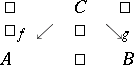 |
Two  -spans
  and
and  are equivalent if for all pairs of morphisms
  either both diagrams
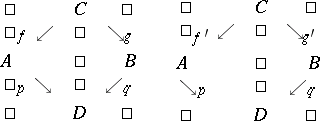 |
commute or both do not commute. A category satisfies the Isbell condition if for all objects  there exists a set of
  -spans
  such that each
  -span is equivalent to precisely one element of
  .
.
References
| [a1] | J. Adamek, "Theory of mathematical structures" , Reidel (1983) pp. Chapt. 6 |
| [a2] | S. MacLane, "Categories for the working mathematician" , Springer (1971) pp. 26 |
A structure is also an obsolete term for lattice.
Comments
References
| [a1] | A.G. Kurosh, "Theory of groups" , 2 , Chelsea, reprint (1955) pp. 85 (Translated from Russian) |
A structure on a manifold, a geometric quantity, a geometric object, or a field of geometric objects, is a section of a bundle associated with the principal bundle of coframes on the manifold  . Intuitively, a geometric quantity can be considered as a quantity whose value depends not only on the point
  of the manifold
  , but also on the choice of the coframe — an infinitesimal system of coordinates at the point
  (see Chart).
More precisely, let  be the general differential group of order
  (the group of
  -jets at zero of transformations of the space
  that preserve the origin), and let
  be the manifold of coframes of order
  of an
of an  -dimensional manifold
  (i.e. the manifold of
  -jets
-jets  of local charts
  with origin at the point
  ). The group
  acts from the left on
  by
by
 |
and this action defines on  the structure of a principal
  -bundle
  , which is called the bundle of coframes of order
  . Let
. Let  be an arbitrary
  -manifold, i.e. a manifold with a left action of the group
  . Finally, let
  be the orbit space of the left action of
  on
on  , while
  is its natural projection onto
  . The bundle
  (associated with
  and
and  ) is called a bundle of geometric structures of order
  and of type
  , while its sections are called structures of type
  . Structures of type
  are in a natural one-to-one correspondence with
  -equivariant mappings
  . Thus, a structure of type
  can be seen as a
  -valued function
  on the manifold
  of
of  -frames that satisfies the following condition of equivariance:
 |
The bundle  of geometric objects is a natural bundle in the sense that the diffeomorphism group of
  acts as the automorphism group of
  .
.
If  is a vector space with a linear (or affine) action of
  , then a structure of type
  is said to be linear (or affine).
A basic example of a linear structure of order one is a tensor structure, or a tensor field. Let  ,
,  and let
  be the space of tensors of type
  with the natural tensor representation of
  . A structure of type
  is called a tensor field of type
  . It can be regarded as a vector function on the manifold of coframes
  which assigns to the coframe
  the set of coordinates
  of the tensor
  , relative to the standard basis
 |
of  . Given a linear transformation of coframes
  , the coordinates
  are transformed in accordance with the tensor representation:
 |
The most important examples of tensor structures are a vector field, a Riemannian metric, a differential form, a symplectic structure, a complex structure, and most commonly, an affinor. All linear structures (of whatever order) are exhausted by Rashevskii super-tensors (see [4]). An example of an affine structure of order two is an affine connection without torsion, which can be regarded as a structure of type  , where
 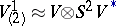 is the kernel of the natural homomorphism
  , considered as a vector space with the natural action of
  . A large and important class of structures is the class of infinitesimally-homogeneous structures or
  -structures (cf.
  -structure) — structures of type
  , where
  is a homogeneous space of the group
  .
.
The above definition of a structure is not sufficiently general, and does not include a number of important geometric structures such as a spinor structure, a symplectic spinor structure, etc. A natural generalization is to study generalized  -structures that are principal bundles with a fixed homomorphism onto a
  -structure, and sections of associated bundles.
References
| [1] | P. Rashevskii, "Caractères tensoriels de l'espace sousprojectif" Trudy Sem. Vektor. i Tenzor. Anal. , 1 (1933) pp. 126–142 |
| [2] | V. Vagner, "The theory of geometric objects and the theory of finite and infinite continuous transformation groups" Dokl. Akad. Nauk SSSR , 46 : 9 (1945) pp. 347–349 (In Russian) |
| [3] | O. Veblen, J.H.C. Whitehead, "The foundations of differential geometry" , Cambridge Univ. Press (1932) |
| [4] | P.K. Rashevskii, "On linear representations of differential groups and Lie groups with nilpotent radical" Trudy Moskov. Mat. Obshch. , 6 (1957) pp. 337–370 (In Russian) |
| [5] | S. Sternberg, "Lectures on differential geometry" , Prentice-Hall (1964) |
| [6] | Ch. Ehresmann, "Introduction à la théorie des structures infinitésimals et des pseudo-groupes de Lie" , Géométrie Diff. Coll. Internat. C.N.R.S. (1953) pp. 97–110 |
D.V. Alekseevskii
Comments
Historically, E. Cartan was the first to introduce the concept of a structure.
References
| [a1] | E. Cartan, "La théorie des groupes et les récherches récentes de géometrie différentielle" Enseign. Math. , 24 (1925) pp. 5–18 |
Structure(2). Encyclopedia of Mathematics. URL: http://encyclopediaofmath.org/index.php?title=Structure(2)&oldid=48881