Difference between revisions of "Bivector space"
(Importing text file) |
Ulf Rehmann (talk | contribs) m (MR/ZBL numbers added) |
||
| Line 26: | Line 26: | ||
====References==== | ====References==== | ||
| − | <table><TR><TD valign="top">[1]</TD> <TD valign="top"> | + | <table><TR><TD valign="top">[1]</TD> <TD valign="top"> A.Z. Petrov, "New methods in general relativity theory" , Moscow (1966) (In Russian)</TD></TR><TR><TD valign="top">[2]</TD> <TD valign="top"> A.P. Norden, "On complex representation of tensors of a biplanar space" , ''8'' ''Kazan. Gos. Univ. Uchen. Zap.'' , '''114''' (1954) pp. 45–53 (In Russian) {{MR|76400}} {{ZBL|}} </TD></TR></table> |
| Line 38: | Line 38: | ||
====References==== | ====References==== | ||
| − | <table><TR><TD valign="top">[a1]</TD> <TD valign="top"> | + | <table><TR><TD valign="top">[a1]</TD> <TD valign="top"> E. Cartan, "Geometry of Riemannian spaces. (With notes and appendices by R. Hermann)" , Math. Sci. Press (1963) (Translated from French)</TD></TR><TR><TD valign="top">[a2]</TD> <TD valign="top"> S. Gołab, "Tensor calculus" , Elsevier (1974) (Translated from Polish) {{MR|}} {{ZBL|0277.53008}} </TD></TR><TR><TD valign="top">[a3]</TD> <TD valign="top"> P.K. [P.K. Rashevskii] Rashewski, "Riemannsche Geometrie und Tensoranalyse" , Deutsch. Verlag Wissenschaft. (1959) (Translated from Russian)</TD></TR><TR><TD valign="top">[a4]</TD> <TD valign="top"> J.A. Schouten, "Ricci-calculus. An introduction to tensor analysis and its geometrical applications" , Springer (1954) pp. 11ff (Translated from German) {{MR|0066025}} {{ZBL|0057.37803}} </TD></TR><TR><TD valign="top">[a5]</TD> <TD valign="top"> R. Bach, "Zur Weylschen Relativitätstheorie und der Weylschen Erweiterung des Krümmungsbegriffs" ''Math. Zeitschr.'' , '''9''' (1921) pp. 110–135 {{MR|1544454}} {{ZBL|}} </TD></TR></table> |
Revision as of 17:31, 31 March 2012
A centro-affine space  (where
  ), which may be assigned to each point of a space
  with an affine connection (in particular, to a Riemannian space
  ). Consider all tensors with even covariant and contravariant valencies at a point of the space
  (or
(or  ); the covariant and contravariant indices are subdivided into different pairs, for each one of which the tensor is skew-symmetric. Tensors with these two properties are called bitensors. If each skew-symmetric pair is regarded as a collective index, the number of new indices will be
  . The simplest bitensor is the bivector
 |
If, at a point  of
of  ,
,
 |
 |
then  , and the set of bivectors assigned to
  (or
(or  ) at a given point defines a vector space of dimension
  such that the components satisfy the conditions
 |
 |
i.e. this set defines the centro-affine space  , called the bivector space at the given point. In
  the bivector space may be metrized with the aid of the metric tensor
 |
after which  becomes a metric space
  .
.
Bivector spaces are used in Riemannian geometry and in the general theory of relativity. The bivector space  is constructed at a given point of the space
  , and different representations of the curvature tensor with components
  ,
,  ,
,  and the second-valency bitensors with components
  ,
,  ,
,  are associated, respectively. The study of the algebraic structure of the curvature tensor may then be reduced to the study of the pencil of quadratic forms
  , the second one of which is non-degenerate (
 ). The study of elementary divisors of this pair results in a classification of the spaces
  . If
. If  (
( ) and if the form
  has signature
  , then it can be shown that only three types of Einstein spaces exist.
A bivector may be assigned to each rotation in  ; this means that in
  there corresponds a vector, which is convenient for the study of infinitesimal transformations. Essentially, a bivector space is identical with a biplanar space [2].
References
| [1] | A.Z. Petrov, "New methods in general relativity theory" , Moscow (1966) (In Russian) |
| [2] | A.P. Norden, "On complex representation of tensors of a biplanar space" , 8 Kazan. Gos. Univ. Uchen. Zap. , 114 (1954) pp. 45–53 (In Russian) MR76400 |
Comments
Consider a bivector as represented by an ordered pair of vectors  as in [a1], [a4] or the article bivector. The Plücker coordinates of
  ,
,  , then constitute a bivector as in the article above. Let
  ,
,  , i.e.
  and similarly for
  . Then the
  transform as
 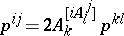 . Whence the formulas above. Here the square brackets in
  are a notation signifying taking an alternating average. Thus
  . If certain indices are to be singled out, i.e. exempt from this averaging process, this is indicated by
  . Thus
  , and
, and  , cf. above. This is a notation introduced by R. Bach [a5]. Cf. also Alternation.
In more modern terms what is described here is the bundle of bivectors over  .
.
A centro-affine space is an affine space with a distinguished point, i.e. practically a vector space. It is not a term which is still greatly used.
References
| [a1] | E. Cartan, "Geometry of Riemannian spaces. (With notes and appendices by R. Hermann)" , Math. Sci. Press (1963) (Translated from French) |
| [a2] | S. Gołab, "Tensor calculus" , Elsevier (1974) (Translated from Polish) Zbl 0277.53008 |
| [a3] | P.K. [P.K. Rashevskii] Rashewski, "Riemannsche Geometrie und Tensoranalyse" , Deutsch. Verlag Wissenschaft. (1959) (Translated from Russian) |
| [a4] | J.A. Schouten, "Ricci-calculus. An introduction to tensor analysis and its geometrical applications" , Springer (1954) pp. 11ff (Translated from German) MR0066025 Zbl 0057.37803 |
| [a5] | R. Bach, "Zur Weylschen Relativitätstheorie und der Weylschen Erweiterung des Krümmungsbegriffs" Math. Zeitschr. , 9 (1921) pp. 110–135 MR1544454 |
Bivector space. Encyclopedia of Mathematics. URL: http://encyclopediaofmath.org/index.php?title=Bivector_space&oldid=14487