Apéry numbers
The Apéry numbers  ,
,  are defined by the finite sums
 |
for every integer  . They were introduced in 1978 by R. Apéry in his highly remarkable irrationality proofs of
  and
and 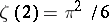 , respectively. In the case of
  , Apéry showed that there exists a sequence of rational numbers
  with denominator dividing
  such that
  for all
  . Together with the fact that
  , this implies the irrationality of
  . For a very lively and amusing account of Apéry's discovery, see [a4]. In 1979 F. Beukers [a1] gave a very short irrationality proof of
  , motivated by the shape of the Apéry numbers. Despite much efforts by many people there is no generalization to an irrationality proof of
  so far (2001).
T. Rival [a5] proved the very surprising result that  for infinitely many
  .
.
It did not take long before people noticed a large number of interesting congruence properties of Apéry numbers. For example,  for all positive integers
  ,
,  and all prime numbers
  . Another congruence is
  for all prime numbers
  . Here,
  denotes the coefficient of
  in the
  -expansion of a modular cusp form. For more details see [a2], [a3].
References
| [a1] | F. Beukers, "A note on the irrationality of  " Bull. London Math. Soc. , 11 (1979) pp. 268–272 " Bull. London Math. Soc. , 11 (1979) pp. 268–272 |
| [a2] | F. Beukers, "Some congruences for the Apéry numbers" J. Number Theory , 21 (1985) pp. 141–155 |
| [a3] | F. Beukers, "Another conguence for the Apéry numbers" J. Number Theory , 25 (1987) pp. 201–210 |
| [a4] | A.J. van der Poorten, "A proof that Euler missed  Apéry's proof of the irrationality of Apéry's proof of the irrationality of  " Math. Intelligencer , 1 (1979) pp. 195–203 " Math. Intelligencer , 1 (1979) pp. 195–203 |
| [a5] | T. Rival, "La fonction zêta de Riemann pren une infinité de valeurs irrationnelles aux entiers impairs" C.R. Acad. Sci. Paris , 331 (2000) pp. 267–270 |
Apéry numbers. Encyclopedia of Mathematics. URL: http://encyclopediaofmath.org/index.php?title=Ap%C3%A9ry_numbers&oldid=22025