Bernoulli integral
of the equations of hydrodynamics
An integral which determines the pressure  at each point of a stationary flow of an ideal homogeneous fluid or a barotropic gas
  in terms of the velocity
  of the flow at that point and the body force function per unit mass
  :
:
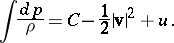 | (1) |
The constant  has a specific value for each flow line and varies from one flow line to another. If the motion is potential, the constant
  is the same for the entire flow.
For a non-stationary flow, the Bernoulli integral (sometimes called the Cauchy–Lagrange integral) holds in the presence of a velocity potential:
 | (2) |
where
 |
and  is an arbitrary function of time.
For an incompressible liquid the left-hand sides of equations (1) and (2) are converted to the  form; for a barotropic gas
  to the form
 |
The integral was presented by D. Bernoulli in 1738.
References
| [1] | L.M. Milne-Thomson, "Theoretical hydrodynamics" , Macmillan (1950) |
Bernoulli integral. Encyclopedia of Mathematics. URL: http://encyclopediaofmath.org/index.php?title=Bernoulli_integral&oldid=18421