Euler-Frobenius polynomials
The Euler–Frobenius polynomials  of degree
  are characterized by the Frobenius reciprocal identity ([a1], [a2], [a3])
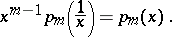 |
Thus,  is invariant under the reflection
 |
of the indeterminate  . The best way to implement an invariance of this kind is to look for an appropriate space with which the Euler–Frobenius polynomials
  are attached in a spectral geometric way.
So, let  denote a symplectic vector space of dimension
  (cf. also Symplectic space). Then the characteristic polynomial of each symplectic automorphism of
  is an Euler–Frobenius polynomial
  of odd degree
  .
.
The proof follows from the fact that the determinant of each symplectic automorphism  of
of  equals
  , so that there is a natural imbedding
 |
Thus,  preserves the symplectic volume spanned by
  vectors of the vector space
  .
.
A consequence is that each eigenvalue  of a symplectic endomorphism
  of
of  having multiplicity
  gives rise to a reciprocal eigenvalue
  of the same multiplicity
  .
.
In view of the self-reciprocal eigenvalue
 |
of  for even
  , of course, spectral theory suggests a complex contour integral representation of the Euler–Frobenius polynomials
  , as follows.
Let  denote a complex number such that
  . Let
. Let  denote a path in the complex plane
  which forms the boundary of a closed vertical strip in the open right or left half-plane of
  according as
  or
or  , respectively. Let
  be oriented so that its topological index satisfies
  . Then, for each integer
  , the complex contour integral representation
 |
holds.
The proof follows from the expansion
 |
with strictly positive integer coefficients, where  denote the basis spline functions (cf. [a3] and also Spline).
A consequence is that the Euler–Frobenius polynomials provide the coefficients of the local power series expansion of the function
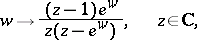 |
which is meromorphic on the complex plane  .
.
The Euler–Frobenius polynomials  satisfy the three-term recurrence relation
 |
A direct proof follows from the complex contour integral representations of the derivatives  , which can be derived from the complex contour integral representation given above for the Euler–Frobenius polynomials.
The preceding recurrence relation opens a simple way to calculate the coefficients of the Euler–Frobenius polynomials  ([a1], [a3]).
References
| [a1] | L. Euler, "Institutiones calculi differentialis cum eius usu in analysi finitorum ac doctrina serierum" , Acad. Imper. Sci. Petropolitanæ (1775) (Opera Omnis Ser. I (Opera Math.), Vol. X, Teubner, 1913) |
| [a2] | F.G. Frobenius, "Über die Bernoullischen Zahlen und die Eulerschen Polynome" Sitzungsber. K. Preuss. Akad. Wissenschaft. Berlin (1910) pp. 809–847 (Gesammelte Abh. Vol. III, pp. 440-478, Springer 1968) |
| [a3] | W. Schempp, "Complex contour integral representation of cardinal spline functions" , Contemp. Math. , 7 , Amer. Math. Soc. (1982) |
Euler-Frobenius polynomials. Encyclopedia of Mathematics. URL: http://encyclopediaofmath.org/index.php?title=Euler-Frobenius_polynomials&oldid=17228