Braess paradox
The words "Braess's paradox" refer to a surprising decrease in performance for some network, which is a result of it being improved locally. The occurrence of this decrease has been studied in mathematical models of equilibrium flow in road/rail traffic, computer networks, telephone networks, water supply systems, electrical circuits, spring systems, and so on. This has been done under various assumptions on routing schemes, such as being state-dependent or fixed.
Below, the occurrence of Braess's paradox in a classical model of user equilibrium traffic flow is given.
Let  be a finite directed graph, with node set
  and arc, branch or link set
  (cf. also Graph, oriented). A path in which all links are similarly directed is called a route, with the initial and final nodes forming an origin/destination pair (or O/D pair). One considers a set
  of O/D pairs, and for each
  , supposes a flow demand
  to be given. Let
  be a set of routes joining
  . For each
  , and
, and  , one considers
  such that
  , giving a route flow vector
  . This route flow induces a link flow
  , by
, by 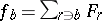 for each
  , where one identifies a route with the set of its links. For each link
  , one supposes a link cost
  , where
  and
and  are given. For
  ,
,  , one defines a route cost by
  .
.
A route flow  is a user equilibrium if it satisfies the condition that for all
  ,
,  , if
, if  then
then  . In other words, there is, for each
  , a common route cost
  for all routes
  with non-zero
  . A user equilibrium flow exists always [a5], and if the matrix
  is such that
  is positive-definite, then the equilibrium link flows, and hence the route costs
  , are unique. In [a3], Braess's paradox is said to occur if adding a new route
  to some
  results in
  being increased. See also [a3] for necessary and sufficient conditions for this to happen under the assumption that there is a strictly positive equilibrium flow in all routes.
There is no fixed definition of Braess's paradox in all systems, but there is a common theme. One assumes some measure of performance,  , such as
  . On the network given by any one link
  ,
,  depends on the flow
  and a parameter
  . For example,
  if the link is given by an M/M/1 queue (cf. also Queue). Note that
  decreases if
  increases, for
  fixed. Suppose some flow demand is fixed and link flows are given by some requirement about equilibria, or by a given dynamical process not in equilibrium. One says that Braess's paradox occurs if, for the network as a whole,
  increases when some
  increases. Adding links may be thought of as changing a parameter
  from zero or infinity. A different language would be used to describe certain other types of networks, such as electrical circuits.
Under this description, the Downs–Thomson paradox [a4] is a particular type of Braess's paradox. If one distinguishes these paradoxes mathematically, it is by requiring the link costs  in the Braess paradox to be increasing functions of the link flow
  , while in the Downs–Thomson paradox there is a link with
  a decreasing function of
  .
.
Independent discoveries of Braess's paradox can be attributed to D. Braess [a1], A. Downs [a4], J.M. Thomson [a6] and C.A. Zukowski and J.L. Wyatt [a7].
[a2] contains an ample list of references.
References
| [a1] | D. Braess, "Über ein Paradoxon aus der Verkehrsplannung" Unternehmensforschung , 12 (1968) pp. 258–268 |
| [a2] | D. Braess, http://homepage.ruhr-uni-bochum.de/Dietrich.Braess (2000) |
| [a3] | S. Dafermos, A. Nagurney, "On some traffic theory equilibrium paradoxes" Transportation Res. B , 18 (1984) pp. 101–110 |
| [a4] | A. Downs, "The law of peak-hour expressway congestion" Traffic Quart. , 16 (1962) pp. 393–409 |
| [a5] | M.J. Smith, "The existence, uniqueness, and stability of traffic equilibria" Transportation Res. B , 13 (1979) pp. 295–304 |
| [a6] | J.M. Thomson, "Great cities and their traffic" , Gollancz, London (1977) |
| [a7] | C.A. Zukowski, J.L. Wyatt, "Sensitivity of nonlinear one-port resistor networks" IEEE Trans. Circuits Syst. , CAS-31 (1984) pp. 1048–1051 |
Braess paradox. Encyclopedia of Mathematics. URL: http://encyclopediaofmath.org/index.php?title=Braess_paradox&oldid=16356