Descriptive geometry
A branch of geometry in which three-dimensional figures, as well as methods for solving and investigating three-dimensional problems, are studied by representing them in the plane. Such representations are constructed by means of central or parallel projection of the figure (nature, an object, an original) on the plane of projection.

Figure: d031370a
The most widespread kind of technical drawing is the composite drawing, constructed by means of an orthogonal projection. Essentially, the procedure is as follows. Choose two mutually perpendicular projection planes,  and
and  . The plane
  is called the horizontal projection plane, and
  is the frontal projection plane. Project an arbitrary point
  in space orthogonally onto these planes (see Fig. a); this gives the horizontal projection
  and the frontal projection
  . It is sometimes useful to add a third — the profile projection
  on the profile plane
  , perpendicular to
  and
and  . To obtain a composite drawing, combining these three projections, make the planes
  and
and  coincide with
  (the "principal" plane) by rotating them about the lines
  and
and  in which they intersect
  (see Fig. b). In practice, the position of the projection axes
  and
and  is usually not marked, i.e. the position of the projection planes is defined only up to a parallel motion.
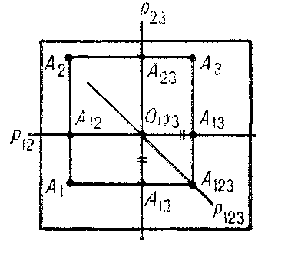
Figure: d031370b
For the construction of more readily visualizable representations, descriptive geometry makes use of an axonometry. To represent objects of considerable extension, one uses drawings obtained by central projection — in other words, in perspective.
References
| [1] | G. Monge, "Géométrie descriptive" , Paris (1820) |
| [2] | N.A. Glagolev, "Descriptive geometry" , Moscow (1953) (In Russian) |
| [3] | , A course of descriptive geometry , Moscow (1956) |
Comments
There are many books on descriptive geometry in the German language, e.g. [a1]. An English language reference is [a2].
A renaissance of descriptive geometry has been sparked by computer graphics; e.g., in matters concerning the two-dimensional graphical representation of three-dimensional objects (perspective, hidden outlines), cf., e.g., [a3], [a4] and references therein.
References
| [a1] | F. Rehbock, "Darstellende Geometrie" , Springer (1969) |
| [a2] | B. Leighton Wellman, "Technical descriptive geometry" , McGraw-Hill (1957) |
| [a3] | M. Bret, "Images de synthèse. Méthodes et algorithmes pour la réalisation d'images numériques" , Dunod (1988) |
| [a4] | M.A. Penna, R.R. Patterson, "Projective geometry and its applications to computer graphics" , Prentice-Hall (1986) |
Descriptive geometry. Encyclopedia of Mathematics. URL: http://encyclopediaofmath.org/index.php?title=Descriptive_geometry&oldid=16046