Flux of a vector field
From Encyclopedia of Mathematics
The printable version is no longer supported and may have rendering errors. Please update your browser bookmarks and please use the default browser print function instead.
A concept in the theory of vector fields. The flux of a vector field  through the surface
  is expressed, up to sign, by the surface integral
 |
where  is the unit normal vector to the surface
  (it is assumed that the vector
  changes continuously over the surface
  ). The flux of the velocity field of a fluid is equal to the volume of fluid passing through the surface
  per unit time.
Comments
The flux of a differential vector field  (defined by the formula above) is related to the divergence of
  :
:
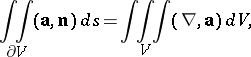 |
where  is the volume element in
  and
and  is the Hamilton operator,
  . This equation is called the divergence theorem or also Green's theorem in space, cf. [a1] and Stokes theorem.
References
| [a1] | M. Spivak, "Calculus on manifolds" , Benjamin (1965) |
How to Cite This Entry:
Flux of a vector field. Encyclopedia of Mathematics. URL: http://encyclopediaofmath.org/index.php?title=Flux_of_a_vector_field&oldid=13812
Flux of a vector field. Encyclopedia of Mathematics. URL: http://encyclopediaofmath.org/index.php?title=Flux_of_a_vector_field&oldid=13812
This article was adapted from an original article by BSE-3 (originator), which appeared in Encyclopedia of Mathematics - ISBN 1402006098. See original article