The printable version is no longer supported and may have rendering errors. Please update your browser bookmarks and please use the default browser print function instead.
Let  be the set of complex
  -matrices and
  . Let
. Let
be the characteristic polynomial of  , where
  is the
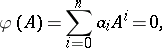
  identity matrix. The Cayley–Hamilton theorem says [a2], [a9] that every square matrix satisfies its own characteristic equation, i.e.
where  is the zero-matrix.
The classical Cayley–Hamilton theorem can be extended to rectangle matrices. A matrix  for
for  may be written as
  ,
,  ,
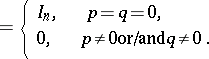
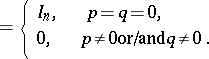
,  . Let
. Let
Then the matrix  (
( ) satisfies the equation [a8]
A matrix  (
( ) may be written as
Let
Then the matrix  (
( ) satisfies the equation [a8]
The Cayley–Hamilton theorem can be also extended to block matrices ([a4], [a13], [a15]). Let
 | (a1) |
where  are commutative, i.e.
  for all
  . Let
. Let
be the matrix characteristic polynomial and let  be the matrix (block) eigenvalue of
  , where
  denotes the Kronecker product. The matrix
  is obtained by developing the determinant of
  , considering its commuting blocks as elements [a15].
The block matrix (a1) satisfies the equation [a15]
Consider now a rectangular block matrix  , where
  has the form (a1) and
  (
( ). The matrix
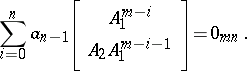
  satisfies the equation [a4]
If 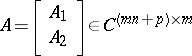 , where
  has the form (a1) and
  , then
A pair of matrices  is called regular if
  for some
  [a10], [a11], [a12]. The pair is called standard if there exist scalars
  such that
  . If the pair
  is regular, then the pair
 | (a2) |
is standard. If the pair  is standard, then it is also commutative (
 ). Let a pair
  be standard (commutative) and
Then the pair satisfies the equation [a1]
In a particular case, with  , it follows that
  .
.
Let  be the set of
  -order square complex matrices that commute in pairs and let
  be the set of square matrices partitioned in
  blocks belonging to
  .
.
Consider a standard pair of block matrices  and let the matrix polynomial
be its matrix characteristic polynomial. The pair  is called the block-eigenvalue pair of the pair
  .
.
Then [a6]
The Cayley–Hamilton theorem can be also extended to singular two-dimensional linear systems described by Roesser-type or Fomasini–Marchesini-type models [a3], [a14]. The singular two-dimensional Roesser model is given by
Here,  is the set of non-negative integers;
  , respectively
  , are the horizontal, respectively vertical, semi-state vector at the point
  ;
;  is the input vector;
  ,
,  (
( ) and
) and  (
( ) have dimensions compatible with
  and
and  ; and
; and
may be singular. The characteristic polynomial has the form
and the transition matrices  ,
,  , are defined by
If  ,
,  (the standard Roesser model), then the transition matrices
  may be computed recursively, using the formula
  , where
  ,
,
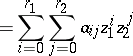
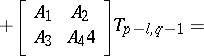
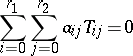
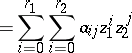
The matrices  satisfy the equation [a3]
The singular two-dimensional Fornasini–Marchesini model is given by
where  is the local semi-vector at the point
  ,
,  is the input vector,
  and
and  is possibly singular. The characteristic polynomial has the form
and the transition matrices  ,
,  , are defined by
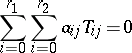
The matrices  satisfy the equation
The theorems may be also extended to two-dimensional continuous-discrete linear systems [a5].
References
| [a1] | F.R. Chang, C.N. Chen, "The generalized Cayley–Hamilton theorem for standard pencils" Systems and Control Lett. , 18 (1992) pp. 179–182 |
| [a2] | F.R. Gantmacher, "The theory of matrices" , 2 , Chelsea (1974) |
| [a3] | T. Kaczorek, "Linear control systems" , I–II , Research Studies Press (1992/93) |
| [a4] | T. Kaczorek, "An extension of the Cayley–Hamilton theorem for non-square blocks matrices and computation of the left and right inverses of matrices" Bull. Polon. Acad. Sci. Techn. , 43 : 1 (1995) pp. 49–56 |
| [a5] | T. Kaczorek, "Extensions of the Cayley Hamilton theorem for  -D continuous discrete linear systems" Appl. Math. and Comput. Sci. , 4 : 4 (1994) pp. 507–515 -D continuous discrete linear systems" Appl. Math. and Comput. Sci. , 4 : 4 (1994) pp. 507–515 |
| [a6] | T. Kaczorek, "An extension of the Cayley–Hamilton theorem for a standard pair of block matrices" Appl. Math. and Comput. Sci. , 8 : 3 (1998) pp. 511–516 |
| [a7] | T. Kaczorek, "An extension of Cayley–Hamillon theorem for singular  -D linear systems with non-square matrices" Bull. Polon. Acad. Sci. Techn. , 43 : 1 (1995) pp. 39–48 -D linear systems with non-square matrices" Bull. Polon. Acad. Sci. Techn. , 43 : 1 (1995) pp. 39–48 |
| [a8] | T. Kaczorek, "Generalizations of the Cayley–Hamilton theorem for nonsquare matrices" Prace Sem. Podstaw Elektrotechnik. i Teor. Obwodów , XVIII–SPETO (1995) pp. 77–83 |
| [a9] | P. Lancaster, "Theory of matrices" , Acad. Press (1969) |
| [a10] | F.L. Lewis, "Cayley--Hamilton theorem and Fadeev's method for the matrix pencil  " , Proc. 22nd IEEE Conf Decision Control (1982) pp. 1282–1288 " , Proc. 22nd IEEE Conf Decision Control (1982) pp. 1282–1288 |
| [a11] | F.L. Lewis, "Further remarks on the Cayley–Hamilton theorem and Leverrie's method for the matrix pencil  " IEEE Trans. Automat. Control , 31 (1986) pp. 869–870 " IEEE Trans. Automat. Control , 31 (1986) pp. 869–870 |
| [a12] | B.G. Mertzios, M.A. Christodoulous, "On the generalized Cayley–Hamilton theorem" IEEE Trans. Automat. Control , 31 (1986) pp. 156–157 |
| [a13] | N.M. Smart, S. Barnett, "The algebra of matrices in  -dimensional systems" Math. Control Inform. , 6 (1989) pp. 121–133 -dimensional systems" Math. Control Inform. , 6 (1989) pp. 121–133 |
| [a14] | N.J. Theodoru, "A Hamilton theorem" IEEE Trans. Automat. Control , AC–34 : 5 (1989) pp. 563–565 |
| [a15] | J. Victoria, "A block-Cayley–Hamilton theorem" Bull. Math. Soc. Sci. Math. Roum. , 26 : 1 (1982) pp. 93–97 |