Resolution of the identity
A one-parameter family  ,
,  , of orthogonal projection operators acting on a Hilbert space
  , such that
1)  if
if  ;
;
2)  is strongly left continuous, i.e.
  for every
  ;
;
3)  as
as  and
and  as
as  ; here 0 and
  are the zero and the identity operator on the space
  .
.
Condition 2) can be replaced by the condition of strong right continuity at every point  .
.
Every self-adjoint operator  acting on
  generates in a unique way a resolution of the identity. Here, in addition to 1)–3), the following conditions also hold:
4) if  is a bounded operator such that
  , then
  for any
  ;
;
5) if  is a bounded operator and
  ,
,  are its greatest lower and least upper bounds, respectively, then
 |
The resolution of the identity given by the operator  completely determines the spectral properties of that operator, namely:
a) a point  is a regular point of
  if and only if it is a point of constancy, that is, if there is a
  such that
  for
for  ;
;
b) a point  is an eigenvalue of
  if and only if at this point
  has a jump, that is,
  ;
;
g) if  , then
  is an invariant subspace of
  .
.
Hence the resolution of the identity determined by the operator  is also called the spectral function of this operator (cf. Spectral resolution).
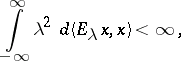
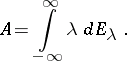
Conversely, every resolution of the identity  uniquely determines a self-adjoint operator
  for which this resolution is the spectral function. The domain of definition
  of
of  consists exactly of those
  for which
 |
and there is a representation of  as an operator Stieltjes integral:
 |
References
| [1] | F. Riesz, B. Szökefalvi-Nagy, "Functional analysis" , F. Ungar (1955) (Translated from French) |
| [2] | N.I. Akhiezer, I.M. Glazman, "Theory of linear operators in a Hilbert space" , 1–2 , F. Ungar (1961–1963) (Translated from Russian) |
| [3] | L.V. Kantorovich, G.P. Akilov, "Functional analysis in normed spaces" , Pergamon (1964) (Translated from Russian) |
Comments
To the property  ) mentioned above one may add that the spectrum of the restriction of
  to
to  is contained in the set
  .
.
Resolution of the identity. Encyclopedia of Mathematics. URL: http://encyclopediaofmath.org/index.php?title=Resolution_of_the_identity&oldid=48529