Fatou theorem (on Lebesgue integrals)
From Encyclopedia of Mathematics
A theorem on passing to the limit under a Lebesgue integral: If a sequence of measurable (real-valued) non-negative functions  converges almost-everywhere on a set
  to a function
  , then
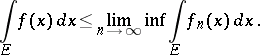 |
It was first proved by P. Fatou [1]. In the statement of it  is often replaced by
  .
.
References
| [1] | P. Fatou, "Séries trigonométriques et séries de Taylor" Acta Math. , 30 (1906) pp. 335–400 |
| [2] | S. Saks, "Theory of the integral" , Hafner (1952) (Translated from French) |
| [3] | I.P. Natanson, "Theorie der Funktionen einer reellen Veränderlichen" , H. Deutsch , Frankfurt a.M. (1961) (Translated from Russian) |
Comments
This result is usually called Fatou's lemma. It holds in a more general form: If  is a measure space,
  is
is  -measurable for
  and
and  for
for  , then
 |
It is not necessary that the sequence converges.
References
| [a1] | E. Hewitt, K.R. Stromberg, "Real and abstract analysis" , Springer (1965) |
| [a2] | P.R. Halmos, "Measure theory" , v. Nostrand (1950) |
How to Cite This Entry:
Fatou theorem (on Lebesgue integrals). Encyclopedia of Mathematics. URL: http://encyclopediaofmath.org/index.php?title=Fatou_theorem_(on_Lebesgue_integrals)&oldid=28189
Fatou theorem (on Lebesgue integrals). Encyclopedia of Mathematics. URL: http://encyclopediaofmath.org/index.php?title=Fatou_theorem_(on_Lebesgue_integrals)&oldid=28189
This article was adapted from an original article by T.P. Lukashenko (originator), which appeared in Encyclopedia of Mathematics - ISBN 1402006098. See original article