One of the numerical characteristics of a function of several variables. It may be considered as a multi-dimensional analogue of the variation of a function of one variable. Let the function 
 be defined on an
  -dimensional parallelepipedon
  . One introduces the following notation:
Let  be an arbitrary subdivision of the parallelepipedon by hyperplanes
into  -dimensional parallelepipeda. Let
  be the least upper bound of sums of the type
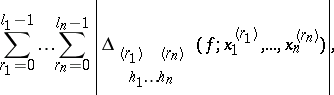 | (*) |
taken over all possible subdivisions of  . If
. If  , one says that the function
  has bounded (finite) Vitali variation on
  , while the class of all such functions is denoted by
  or simply by
  . The class was defined by G. Vitali [1]. The same definition of variation was subsequently proposed by H. Lebesgue [2] and M. Fréchet [3]. A real-valued function
  , defined on
  , belongs to the class
  if and only if it can be represented in the form
  , where the functions
  and
and  are such that, for each of them, the sums of the type (*), taken without the modulus sign, are non-negative [4] (the analogue of the Jordan decomposition of a function of bounded variation of one variable). The functions of class
  may be used to introduce the multi-dimensional Stieltjes integral. In particular, for any function
  which is continuous on
  and any function
  of class
  the integral
  exists [3].
References
| [1] | G. Vitali, "Sui gruppi di punti e sulle funzioni di variabili reali" Atti Accad. Sci. Torino , 43 (1908) pp. 75–92 |
| [2] | H. Lebesgue, "Sur l'intégration des fonctions discontinues" Ann. Sci. École Norm. Sup. (3) , 27 (1910) pp. 361–450 |
| [3] | M. Fréchet, "Extension au cas d'intégrales multiples d'une définition de l'intégrale due à Stieltjes" Nouv. Ann. Math. ser. 4 , 10 (1910) pp. 241–256 |
| [4] | H. Hahn, "Theorie der reellen Funktionen" , 1 , Springer (1921) |
| [5] | F. Riesz, B. Szökefalvi-Nagy, "Functional analysis" , F. Ungar (1955) (Translated from French) |
How to Cite This Entry:
Vitali variation. Encyclopedia of Mathematics. URL: http://encyclopediaofmath.org/index.php?title=Vitali_variation&oldid=27961
This article was adapted from an original article by B.I. Golubov (originator), which appeared in Encyclopedia of Mathematics - ISBN 1402006098.
See original article



