Difference between revisions of "Perron-Frobenius theorem"
Ulf Rehmann (talk | contribs) m (tex encoded by computer) |
Ulf Rehmann (talk | contribs) m (Undo revision 48164 by Ulf Rehmann (talk)) Tag: Undo |
||
| Line 1: | Line 1: | ||
| − | < | + | Let a real square <img align="absmiddle" border="0" src="https://www.encyclopediaofmath.org/legacyimages/p/p072/p072350/p0723501.png" />-matrix <img align="absmiddle" border="0" src="https://www.encyclopediaofmath.org/legacyimages/p/p072/p072350/p0723502.png" /> be considered as an operator on <img align="absmiddle" border="0" src="https://www.encyclopediaofmath.org/legacyimages/p/p072/p072350/p0723503.png" />, let it be without invariant coordinate subspaces (such a matrix is called indecomposable) and let it be non-negative (i.e. all its elements are non-negative). Also, let <img align="absmiddle" border="0" src="https://www.encyclopediaofmath.org/legacyimages/p/p072/p072350/p0723504.png" /> be its eigen values, enumerated such that |
| − | p0723501.png | ||
| − | |||
| − | |||
| − | |||
| − | |||
| − | |||
| − | |||
| − | + | <table class="eq" style="width:100%;"> <tr><td valign="top" style="width:94%;text-align:center;"><img align="absmiddle" border="0" src="https://www.encyclopediaofmath.org/legacyimages/p/p072/p072350/p0723505.png" /></td> </tr></table> | |
| − | |||
| − | |||
| − | |||
| − | |||
| − | |||
| − | |||
| − | |||
| − | |||
| − | |||
| − | |||
| − | |||
| − | |||
| − | |||
Then, | Then, | ||
| − | 1) the number | + | 1) the number <img align="absmiddle" border="0" src="https://www.encyclopediaofmath.org/legacyimages/p/p072/p072350/p0723506.png" /> is a simple positive root of the [[Characteristic polynomial|characteristic polynomial]] of <img align="absmiddle" border="0" src="https://www.encyclopediaofmath.org/legacyimages/p/p072/p072350/p0723507.png" />; |
| − | is a simple positive root of the [[Characteristic polynomial|characteristic polynomial]] of | ||
| − | 2) there exists an eigen vector of | + | 2) there exists an eigen vector of <img align="absmiddle" border="0" src="https://www.encyclopediaofmath.org/legacyimages/p/p072/p072350/p0723508.png" /> with positive coordinates corresponding to <img align="absmiddle" border="0" src="https://www.encyclopediaofmath.org/legacyimages/p/p072/p072350/p0723509.png" />; |
| − | with positive coordinates corresponding to | ||
| − | 3) the numbers | + | 3) the numbers <img align="absmiddle" border="0" src="https://www.encyclopediaofmath.org/legacyimages/p/p072/p072350/p07235010.png" /> coincide, apart from their numbering, with the numbers <img align="absmiddle" border="0" src="https://www.encyclopediaofmath.org/legacyimages/p/p072/p072350/p07235011.png" />, where <img align="absmiddle" border="0" src="https://www.encyclopediaofmath.org/legacyimages/p/p072/p072350/p07235012.png" />; |
| − | coincide, apart from their numbering, with the numbers | ||
| − | where | ||
| − | 4) the product of any eigen value of | + | 4) the product of any eigen value of <img align="absmiddle" border="0" src="https://www.encyclopediaofmath.org/legacyimages/p/p072/p072350/p07235013.png" /> by <img align="absmiddle" border="0" src="https://www.encyclopediaofmath.org/legacyimages/p/p072/p072350/p07235014.png" /> is an eigen value of <img align="absmiddle" border="0" src="https://www.encyclopediaofmath.org/legacyimages/p/p072/p072350/p07235015.png" />; |
| − | by | ||
| − | is an eigen value of | ||
| − | 5) for | + | 5) for <img align="absmiddle" border="0" src="https://www.encyclopediaofmath.org/legacyimages/p/p072/p072350/p07235016.png" /> one can find a permutation of the rows and columns that reduces <img align="absmiddle" border="0" src="https://www.encyclopediaofmath.org/legacyimages/p/p072/p072350/p07235017.png" /> to the form |
| − | one can find a permutation of the rows and columns that reduces | ||
| − | to the form | ||
| − | + | <table class="eq" style="width:100%;"> <tr><td valign="top" style="width:94%;text-align:center;"><img align="absmiddle" border="0" src="https://www.encyclopediaofmath.org/legacyimages/p/p072/p072350/p07235018.png" /></td> </tr></table> | |
| − | |||
| − | where | + | where <img align="absmiddle" border="0" src="https://www.encyclopediaofmath.org/legacyimages/p/p072/p072350/p07235019.png" /> is a matrix of order <img align="absmiddle" border="0" src="https://www.encyclopediaofmath.org/legacyimages/p/p072/p072350/p07235020.png" />. |
| − | is a matrix of order | ||
O. Perron proved the assertions 1) and 2) for positive matrices in [[#References|[1]]], while G. Frobenius [[#References|[2]]] gave the full form of the theorem. | O. Perron proved the assertions 1) and 2) for positive matrices in [[#References|[1]]], while G. Frobenius [[#References|[2]]] gave the full form of the theorem. | ||
| Line 53: | Line 23: | ||
====References==== | ====References==== | ||
<table><TR><TD valign="top">[1]</TD> <TD valign="top"> O. Perron, "Zur Theorie der Matrizen" ''Math. Ann.'' , '''64''' (1907) pp. 248–263</TD></TR><TR><TD valign="top">[2]</TD> <TD valign="top"> G. Frobenius, "Ueber Matrizen aus nicht negativen Elementen" ''Sitzungsber. Königl. Preuss. Akad. Wiss.'' (1912) pp. 456–477</TD></TR><TR><TD valign="top">[3]</TD> <TD valign="top"> F.R. [F.R. Gantmakher] Gantmacher, "The theory of matrices" , '''1''' , Chelsea, reprint (1977) (Translated from Russian)</TD></TR></table> | <table><TR><TD valign="top">[1]</TD> <TD valign="top"> O. Perron, "Zur Theorie der Matrizen" ''Math. Ann.'' , '''64''' (1907) pp. 248–263</TD></TR><TR><TD valign="top">[2]</TD> <TD valign="top"> G. Frobenius, "Ueber Matrizen aus nicht negativen Elementen" ''Sitzungsber. Königl. Preuss. Akad. Wiss.'' (1912) pp. 456–477</TD></TR><TR><TD valign="top">[3]</TD> <TD valign="top"> F.R. [F.R. Gantmakher] Gantmacher, "The theory of matrices" , '''1''' , Chelsea, reprint (1977) (Translated from Russian)</TD></TR></table> | ||
| + | |||
| + | |||
====Comments==== | ====Comments==== | ||
Revision as of 14:52, 7 June 2020
Let a real square  -matrix
  be considered as an operator on
  , let it be without invariant coordinate subspaces (such a matrix is called indecomposable) and let it be non-negative (i.e. all its elements are non-negative). Also, let
  be its eigen values, enumerated such that
 |
Then,
1) the number  is a simple positive root of the characteristic polynomial of
  ;
;
2) there exists an eigen vector of  with positive coordinates corresponding to
  ;
;
3) the numbers  coincide, apart from their numbering, with the numbers
  , where
  ;
;
4) the product of any eigen value of  by
by  is an eigen value of
  ;
;
5) for  one can find a permutation of the rows and columns that reduces
  to the form
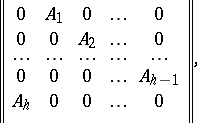 |
where  is a matrix of order
  .
.
O. Perron proved the assertions 1) and 2) for positive matrices in [1], while G. Frobenius [2] gave the full form of the theorem.
References
| [1] | O. Perron, "Zur Theorie der Matrizen" Math. Ann. , 64 (1907) pp. 248–263 |
| [2] | G. Frobenius, "Ueber Matrizen aus nicht negativen Elementen" Sitzungsber. Königl. Preuss. Akad. Wiss. (1912) pp. 456–477 |
| [3] | F.R. [F.R. Gantmakher] Gantmacher, "The theory of matrices" , 1 , Chelsea, reprint (1977) (Translated from Russian) |
Comments
The Perron–Frobenius theorem has numerous applications, cf. [a1], [a2].
References
| [a1] | E. Seneta, "Nonnegative matrices" , Allen & Unwin (1973) |
| [a2] | K. Lancaster, "Mathematical economics" , Macmillan (1968) |
Perron-Frobenius theorem. Encyclopedia of Mathematics. URL: http://encyclopediaofmath.org/index.php?title=Perron-Frobenius_theorem&oldid=48164