Difference between revisions of "Taylor joint spectrum"
(Importing text file) |
Ulf Rehmann (talk | contribs) m (MR/ZBL numbers added) |
||
| Line 31: | Line 31: | ||
so <img align="absmiddle" border="0" src="https://www.encyclopediaofmath.org/legacyimages/t/t130/t130050/t13005073.png" />. | so <img align="absmiddle" border="0" src="https://www.encyclopediaofmath.org/legacyimages/t/t130/t130050/t13005073.png" />. | ||
| − | Note that since <img align="absmiddle" border="0" src="https://www.encyclopediaofmath.org/legacyimages/t/t130/t130050/t13005074.png" /> is defined in terms of the actions of the operators <img align="absmiddle" border="0" src="https://www.encyclopediaofmath.org/legacyimages/t/t130/t130050/t13005075.png" /> on vectors of <img align="absmiddle" border="0" src="https://www.encyclopediaofmath.org/legacyimages/t/t130/t130050/t13005076.png" />, it is intrinsically | + | Note that since <img align="absmiddle" border="0" src="https://www.encyclopediaofmath.org/legacyimages/t/t130/t130050/t13005074.png" /> is defined in terms of the actions of the operators <img align="absmiddle" border="0" src="https://www.encyclopediaofmath.org/legacyimages/t/t130/t130050/t13005075.png" /> on vectors of <img align="absmiddle" border="0" src="https://www.encyclopediaofmath.org/legacyimages/t/t130/t130050/t13005076.png" />, it is intrinsically "spatial" , as opposed to <img align="absmiddle" border="0" src="https://www.encyclopediaofmath.org/legacyimages/t/t130/t130050/t13005077.png" />, <img align="absmiddle" border="0" src="https://www.encyclopediaofmath.org/legacyimages/t/t130/t130050/t13005078.png" /> and other algebraic joint spectra. <img align="absmiddle" border="0" src="https://www.encyclopediaofmath.org/legacyimages/t/t130/t130050/t13005079.png" /> contains other well-known spatial spectra, like <img align="absmiddle" border="0" src="https://www.encyclopediaofmath.org/legacyimages/t/t130/t130050/t13005080.png" /> (the point spectrum), <img align="absmiddle" border="0" src="https://www.encyclopediaofmath.org/legacyimages/t/t130/t130050/t13005081.png" /> (the approximate point spectrum) and <img align="absmiddle" border="0" src="https://www.encyclopediaofmath.org/legacyimages/t/t130/t130050/t13005082.png" /> (the defect spectrum). Moreover, if <img align="absmiddle" border="0" src="https://www.encyclopediaofmath.org/legacyimages/t/t130/t130050/t13005083.png" /> is a commutative Banach algebra, <img align="absmiddle" border="0" src="https://www.encyclopediaofmath.org/legacyimages/t/t130/t130050/t13005084.png" />, with each <img align="absmiddle" border="0" src="https://www.encyclopediaofmath.org/legacyimages/t/t130/t130050/t13005085.png" />, and <img align="absmiddle" border="0" src="https://www.encyclopediaofmath.org/legacyimages/t/t130/t130050/t13005086.png" /> denotes the <img align="absmiddle" border="0" src="https://www.encyclopediaofmath.org/legacyimages/t/t130/t130050/t13005087.png" />-tuple of left multiplications by the <img align="absmiddle" border="0" src="https://www.encyclopediaofmath.org/legacyimages/t/t130/t130050/t13005088.png" />s, it is not hard to show that <img align="absmiddle" border="0" src="https://www.encyclopediaofmath.org/legacyimages/t/t130/t130050/t13005089.png" />. As a matter of fact, the same result holds when <img align="absmiddle" border="0" src="https://www.encyclopediaofmath.org/legacyimages/t/t130/t130050/t13005090.png" /> is not commutative, provided all the <img align="absmiddle" border="0" src="https://www.encyclopediaofmath.org/legacyimages/t/t130/t130050/t13005091.png" />s come from the centre of <img align="absmiddle" border="0" src="https://www.encyclopediaofmath.org/legacyimages/t/t130/t130050/t13005092.png" />. |
===Spectral permanence.=== | ===Spectral permanence.=== | ||
| Line 94: | Line 94: | ||
<table class="eq" style="width:100%;"> <tr><td valign="top" style="width:94%;text-align:center;"><img align="absmiddle" border="0" src="https://www.encyclopediaofmath.org/legacyimages/t/t130/t130050/t130050182.png" /></td> </tr></table> | <table class="eq" style="width:100%;"> <tr><td valign="top" style="width:94%;text-align:center;"><img align="absmiddle" border="0" src="https://www.encyclopediaofmath.org/legacyimages/t/t130/t130050/t130050182.png" /></td> </tr></table> | ||
| − | During the 1980s and 1990s, Taylor spectral theory has received considerable attention; for further details and information, see [[#References|[a2]]], [[#References|[a11]]], [[#References|[a20]]], [[#References|[a10]]], [[#References|[a1]]]. There is also a parallel | + | During the 1980s and 1990s, Taylor spectral theory has received considerable attention; for further details and information, see [[#References|[a2]]], [[#References|[a11]]], [[#References|[a20]]], [[#References|[a10]]], [[#References|[a1]]]. There is also a parallel "local spectral theory" , described in [[#References|[a11]]], [[#References|[a12]]] and [[#References|[a20]]]. |
====References==== | ====References==== | ||
| − | <table><TR><TD valign="top">[a1]</TD> <TD valign="top"> | + | <table><TR><TD valign="top">[a1]</TD> <TD valign="top"> E. Albrecht, F.-H. Vasilescu, "Semi-Fredholm complexes" ''Oper. Th. Adv. Appl.'' , '''11''' (1983) pp. 15–39 {{MR|0789629}} {{ZBL|0527.47008}} </TD></TR><TR><TD valign="top">[a2]</TD> <TD valign="top"> C.-G. Ambrozie, F.-H. Vasilescu, "Banach space complexes" , Kluwer Acad. Publ. (1995) {{MR|1357165}} {{ZBL|0837.47009}} </TD></TR><TR><TD valign="top">[a3]</TD> <TD valign="top"> C. Berger, L. Coburn, A. Koranyi, "Opérateurs de Wiener–Hopf sur les spheres de Lie" ''C.R. Acad. Sci. Paris Sér. A'' , '''290''' (1980) pp. 989–991 {{MR|584284}} {{ZBL|0436.47021}} </TD></TR><TR><TD valign="top">[a4]</TD> <TD valign="top"> C. Berger, L. Coburn, "Wiener–Hopf operators on <img align="absmiddle" border="0" src="https://www.encyclopediaofmath.org/legacyimages/t/t130/t130050/t130050183.png" />" ''Integral Eq. Oper. Th.'' , '''2''' (1979) pp. 139–173 {{MR|0543881}} {{ZBL|0434.47019}} </TD></TR><TR><TD valign="top">[a5]</TD> <TD valign="top"> R. Curto, L. Fialkow, "The spectral picture of <img align="absmiddle" border="0" src="https://www.encyclopediaofmath.org/legacyimages/t/t130/t130050/t130050184.png" />" ''J. Funct. Anal.'' , '''71''' (1987) pp. 371–392 {{MR|0880986}} {{ZBL|0626.47018}} </TD></TR><TR><TD valign="top">[a6]</TD> <TD valign="top"> R. Curto, P. Muhly, "<img align="absmiddle" border="0" src="https://www.encyclopediaofmath.org/legacyimages/t/t130/t130050/t130050185.png" />-algebras of multiplication operators on Bergman spaces" ''J. Funct. Anal.'' , '''64''' (1985) pp. 315–329 {{MR|0813203}} {{ZBL|0583.46049}} </TD></TR><TR><TD valign="top">[a7]</TD> <TD valign="top"> R. Curto, N. Salinas, "Spectral properties of cyclic subnormal <img align="absmiddle" border="0" src="https://www.encyclopediaofmath.org/legacyimages/t/t130/t130050/t130050186.png" />-tuples" ''Amer. J. Math.'' , '''107''' (1985) pp. 113–138 {{MR|778091}} {{ZBL|}} </TD></TR><TR><TD valign="top">[a8]</TD> <TD valign="top"> R. Curto, K. Yan, "The spectral picture of Reinhardt measures" ''J. Funct. Anal.'' , '''131''' (1995) pp. 279–301 {{MR|1345033}} {{ZBL|0826.47002}} </TD></TR><TR><TD valign="top">[a9]</TD> <TD valign="top"> R. Curto, "Spectral permanence for joint spectra" ''Trans. Amer. Math. Soc.'' , '''270''' (1982) pp. 659–665 {{MR|0645336}} {{ZBL|0508.47039}} {{ZBL|0491.47020}} </TD></TR><TR><TD valign="top">[a10]</TD> <TD valign="top"> R. Curto, "Applications of several complex variables to multiparameter spectral theory" J.B. Conway (ed.) B.B. Morrel (ed.) , ''Surveys of Some Recent Results in Operator Theory II'' , ''Pitman Res. Notes in Math.'' , '''192''' , Longman Sci. Tech. (1988) pp. 25–90 {{MR|0976843}} {{ZBL|0827.47005}} </TD></TR><TR><TD valign="top">[a11]</TD> <TD valign="top"> J. Eschmeier, M. Putinar, "Spectral decompositions and analytic sheaves" , ''London Math. Soc. Monographs'' , Oxford Sci. Publ. (1996) {{MR|1420618}} {{ZBL|0855.47013}} </TD></TR><TR><TD valign="top">[a12]</TD> <TD valign="top"> K. Laursen, M. Neumann, "Introduction to local spectral theory" , ''London Math. Soc. Monographs'' , Oxford Univ. Press (2000) {{MR|1747914}} {{ZBL|0957.47004}} </TD></TR><TR><TD valign="top">[a13]</TD> <TD valign="top"> M. Putinar, "Uniqueness of Taylor's functional calculus" ''Proc. Amer. Math. Soc.'' , '''89''' (1983) pp. 647–650 {{MR|718990}} {{ZBL|}} </TD></TR><TR><TD valign="top">[a14]</TD> <TD valign="top"> M. Putinar, "Spectral inclusion for subnormal <img align="absmiddle" border="0" src="https://www.encyclopediaofmath.org/legacyimages/t/t130/t130050/t130050187.png" />-tuples" ''Proc. Amer. Math. Soc.'' , '''90''' (1984) pp. 405–406 {{MR|728357}} {{ZBL|}} </TD></TR><TR><TD valign="top">[a15]</TD> <TD valign="top"> N. Salinas, A. Sheu, H. Upmeier, "Toeplitz operators on pseudoconvex domains and foliation <img align="absmiddle" border="0" src="https://www.encyclopediaofmath.org/legacyimages/t/t130/t130050/t130050188.png" />-algebras" ''Ann. of Math.'' , '''130''' (1989) pp. 531–565 {{MR|1025166}} {{ZBL|}} </TD></TR><TR><TD valign="top">[a16]</TD> <TD valign="top"> N. Salinas, "The <img align="absmiddle" border="0" src="https://www.encyclopediaofmath.org/legacyimages/t/t130/t130050/t130050189.png" />-formalism and the <img align="absmiddle" border="0" src="https://www.encyclopediaofmath.org/legacyimages/t/t130/t130050/t130050190.png" />-algebra of the Bergman <img align="absmiddle" border="0" src="https://www.encyclopediaofmath.org/legacyimages/t/t130/t130050/t130050191.png" />-tuple" ''J. Oper. Th.'' , '''22''' (1989) pp. 325–343 {{MR|1043731}} {{ZBL|}} </TD></TR><TR><TD valign="top">[a17]</TD> <TD valign="top"> J.L. Taylor, "A joint spectrum for several commuting operators" ''J. Funct. Anal.'' , '''6''' (1970) pp. 172–191 {{MR|0268706}} {{ZBL|0233.47024}} </TD></TR><TR><TD valign="top">[a18]</TD> <TD valign="top"> J.L. Taylor, "The analytic functional calculus for several commuting operators" ''Acta Math.'' , '''125''' (1970) pp. 1–48 {{MR|0271741}} {{ZBL|0233.47025}} </TD></TR><TR><TD valign="top">[a19]</TD> <TD valign="top"> H. Upmeier, "Toeplitz <img align="absmiddle" border="0" src="https://www.encyclopediaofmath.org/legacyimages/t/t130/t130050/t130050192.png" />-algebras on bounded symmetric domains" ''Ann. of Math.'' , '''119''' (1984) pp. 549–576 {{MR|744863}} {{ZBL|}} </TD></TR><TR><TD valign="top">[a20]</TD> <TD valign="top"> F.-H. Vasilescu, "Analytic functional calculus and spectral decompositions" , Reidel (1982) {{MR|0690957}} {{ZBL|0495.47013}} </TD></TR><TR><TD valign="top">[a21]</TD> <TD valign="top"> U. Venugopalkrishna, "Fredholm operators associated with strongly pseudoconvex domains in <img align="absmiddle" border="0" src="https://www.encyclopediaofmath.org/legacyimages/t/t130/t130050/t130050193.png" />" ''J. Funct. Anal.'' , '''9''' (1972) pp. 349–373 {{MR|0315502}} {{ZBL|0241.47023}} </TD></TR></table> |
Revision as of 17:02, 15 April 2012
Let  be the exterior algebra on
  generators
  , with identity
  .
.  is the algebra of forms in
  with complex coefficients, subject to the collapsing property
  (
( ). Let
  denote the creation operator, given by
  (
( ,
,  ). If one declares
  to be an orthonormal basis, the exterior algebra
  becomes a Hilbert space, admitting an orthogonal decomposition
 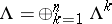 , where
 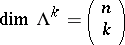 . Thus, each
  admits a unique orthogonal decomposition
  , where
  and
and  have no
  contribution. It then readily follows that
  . Indeed, each
  is a partial isometry, satisfying
  (
( ).
).
Let  be a normed space, let
  be a commuting
  -tuple of bounded operators on
  and set
  . One defines
  by
by  . Clearly,
  , so
, so  .
.
The commuting  -tuple
  is said to be non-singular on
  if
if  . The Taylor joint spectrum, or simply the Taylor spectrum, of
  on
on  is the set
 |
The decomposition 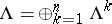 gives rise to a cochain complex
  , the so-called Koszul complex associated to
  on
on  , as follows:
 |
where  denotes the restriction of
  to the subspace
  . Thus,
 |
J.L. Taylor showed in [a17] that if  is a Banach space, then
  is compact, non-empty, and contained in
  , the (joint) algebraic spectrum of
  (cf. also Spectrum of an operator) with respect to the commutant of
  ,
,  . Moreover,
  carries an analytic functional calculus with values in the double commutant of
  , so that, in particular,
  possesses the projection property.
Example:  .
.
For  ,
,  admits the following
  -matrix relative to the direct sum decomposition
  :
:
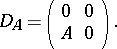 |
Then  . It follows at once that
  agrees with
  , the spectrum of
  .
.
Example:  .
.
For  ,
,
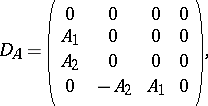 |
so  .
.
Note that since  is defined in terms of the actions of the operators
  on vectors of
  , it is intrinsically "spatial" , as opposed to
  ,
,  and other algebraic joint spectra.
  contains other well-known spatial spectra, like
  (the point spectrum),
  (the approximate point spectrum) and
  (the defect spectrum). Moreover, if
  is a commutative Banach algebra,
  , with each
  , and
, and  denotes the
  -tuple of left multiplications by the
  s, it is not hard to show that
  . As a matter of fact, the same result holds when
  is not commutative, provided all the
  s come from the centre of
  .
.
Spectral permanence.
When  is a
is a  -algebra, say
  , then
  [a9]. This fact, known as spectral permanence for the Taylor spectrum, shows that for
  -algebra elements (and also for Hilbert space operators), the non-singularity of
  is equivalent to the invertibility of the associated Dirac operator
  .
.
Finite-dimensional case.
When  ,
,
 |
where  ,
,  and
and  denote the left, right and polynomially convex spectra, respectively. As a matter of fact, in this case the commuting
  -tuple
  can be simultaneously triangularized as
 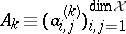 , and
, and
 |
Case of compact operators.
If  is a commuting
  -tuple of compact operators acting on a Banach space
  , then
  is countable, with
  as the only accumulation point. Moreover,
  .
.
Invariant subspaces.
If  is a Banach space,
  is a closed subspace of
  and
and  is a commuting
  -tuple leaving
  invariant, then the union of any two of the sets
  ,
,  and
and  contains the third [a17]. This can be seen by looking at the long cohomology sequence associated to the Koszul complex and the canonical short exact sequence
  .
.
Additional properties.
In addition to the above-mentioned properties of  , the following facts can be found in the survey article [a10] and the references therein:
i)  gives rise to a compact non-empty subset
  of the maximal ideal space of any commutative Banach algebra
  containing
  , in such a way that
  [a17];
ii) for  ,
,  , where
  denotes the Harte spectrum;
iii) the upper semi-continuity of separate parts holds for the Taylor spectrum;
iv) every isolated point in  is an isolated point of
  (and, a fortiori, an isolated point of
  );
);
v) if  , up to approximate unitary equivalence one can always assume that
  [a5];
[a5];
vi) the functional calculus introduced by Taylor in [a18] admits a concrete realization in terms of the Bochner–Martinelli kernel (cf. Bochner–Martinelli representation formula) in case  acts on a Hilbert space or on a
  -algebra [a20];
vii) M. Putinar established in [a13] the uniqueness of the functional calculus, provided it extends the polynomial calculus.
Fredholm  -tuples.
In a way entirely similar to the development of Fredholm theory, one can define the notion of Fredholm  -tuple: a commuting
  -tuple
  is said to be Fredholm on
  if the associated Koszul complex
  has finite-dimensional cohomology spaces. The Taylor essential spectrum of
  on
on  is then
 |
The Fredholm index of  is defined as the Euler characteristic of
  . For example, if
  ,
,  . In a Hilbert space,
  , where
  is the coset of
  in the Calkin algebra for
  .
.
Example.
If  and
and  (
( ), then
  ,
,  , and
, and  (
( ).
).
The Taylor spectral and Fredholm theories of multiplication operators acting on Bergman spaces over Reinhardt domains or bounded pseudo-convex domains, or acting on the Hardy spaces over the Shilov boundary of bounded symmetric domains on several complex variables, have been described in [a4], [a3], [a6], [a7], [a8], [a16], [a15], [a19], and [a21]; for Toeplitz operators with  symbols acting on bounded pseudo-convex domains, concrete descriptions appear in [a11].
Spectral inclusion.
If  is a subnormal
  -tuple acting on
  with minimal normal extension
  acting on
  (cf. also Normal operator),
  [a14].
Left and right multiplications.
For  and
and  two commuting
  -tuples of operators on a Hilbert space
  , and
, and  and
and  the associated
  -tuples of left and right multiplication operators [a5],
 |
and
 |
 |
During the 1980s and 1990s, Taylor spectral theory has received considerable attention; for further details and information, see [a2], [a11], [a20], [a10], [a1]. There is also a parallel "local spectral theory" , described in [a11], [a12] and [a20].
References
| [a1] | E. Albrecht, F.-H. Vasilescu, "Semi-Fredholm complexes" Oper. Th. Adv. Appl. , 11 (1983) pp. 15–39 MR0789629 Zbl 0527.47008 |
| [a2] | C.-G. Ambrozie, F.-H. Vasilescu, "Banach space complexes" , Kluwer Acad. Publ. (1995) MR1357165 Zbl 0837.47009 |
| [a3] | C. Berger, L. Coburn, A. Koranyi, "Opérateurs de Wiener–Hopf sur les spheres de Lie" C.R. Acad. Sci. Paris Sér. A , 290 (1980) pp. 989–991 MR584284 Zbl 0436.47021 |
| [a4] | C. Berger, L. Coburn, "Wiener–Hopf operators on  " Integral Eq. Oper. Th. , 2 (1979) pp. 139–173 MR0543881 Zbl 0434.47019 " Integral Eq. Oper. Th. , 2 (1979) pp. 139–173 MR0543881 Zbl 0434.47019 |
| [a5] | R. Curto, L. Fialkow, "The spectral picture of  " J. Funct. Anal. , 71 (1987) pp. 371–392 MR0880986 Zbl 0626.47018 " J. Funct. Anal. , 71 (1987) pp. 371–392 MR0880986 Zbl 0626.47018 |
| [a6] | R. Curto, P. Muhly, " -algebras of multiplication operators on Bergman spaces" J. Funct. Anal. , 64 (1985) pp. 315–329 MR0813203 Zbl 0583.46049 -algebras of multiplication operators on Bergman spaces" J. Funct. Anal. , 64 (1985) pp. 315–329 MR0813203 Zbl 0583.46049 |
| [a7] | R. Curto, N. Salinas, "Spectral properties of cyclic subnormal  -tuples" Amer. J. Math. , 107 (1985) pp. 113–138 MR778091 -tuples" Amer. J. Math. , 107 (1985) pp. 113–138 MR778091 |
| [a8] | R. Curto, K. Yan, "The spectral picture of Reinhardt measures" J. Funct. Anal. , 131 (1995) pp. 279–301 MR1345033 Zbl 0826.47002 |
| [a9] | R. Curto, "Spectral permanence for joint spectra" Trans. Amer. Math. Soc. , 270 (1982) pp. 659–665 MR0645336 Zbl 0508.47039 Zbl 0491.47020 |
| [a10] | R. Curto, "Applications of several complex variables to multiparameter spectral theory" J.B. Conway (ed.) B.B. Morrel (ed.) , Surveys of Some Recent Results in Operator Theory II , Pitman Res. Notes in Math. , 192 , Longman Sci. Tech. (1988) pp. 25–90 MR0976843 Zbl 0827.47005 |
| [a11] | J. Eschmeier, M. Putinar, "Spectral decompositions and analytic sheaves" , London Math. Soc. Monographs , Oxford Sci. Publ. (1996) MR1420618 Zbl 0855.47013 |
| [a12] | K. Laursen, M. Neumann, "Introduction to local spectral theory" , London Math. Soc. Monographs , Oxford Univ. Press (2000) MR1747914 Zbl 0957.47004 |
| [a13] | M. Putinar, "Uniqueness of Taylor's functional calculus" Proc. Amer. Math. Soc. , 89 (1983) pp. 647–650 MR718990 |
| [a14] | M. Putinar, "Spectral inclusion for subnormal  -tuples" Proc. Amer. Math. Soc. , 90 (1984) pp. 405–406 MR728357 -tuples" Proc. Amer. Math. Soc. , 90 (1984) pp. 405–406 MR728357 |
| [a15] | N. Salinas, A. Sheu, H. Upmeier, "Toeplitz operators on pseudoconvex domains and foliation  -algebras" Ann. of Math. , 130 (1989) pp. 531–565 MR1025166 -algebras" Ann. of Math. , 130 (1989) pp. 531–565 MR1025166 |
| [a16] | N. Salinas, "The  -formalism and the -formalism and the  -algebra of the Bergman -algebra of the Bergman  -tuple" J. Oper. Th. , 22 (1989) pp. 325–343 MR1043731 -tuple" J. Oper. Th. , 22 (1989) pp. 325–343 MR1043731 |
| [a17] | J.L. Taylor, "A joint spectrum for several commuting operators" J. Funct. Anal. , 6 (1970) pp. 172–191 MR0268706 Zbl 0233.47024 |
| [a18] | J.L. Taylor, "The analytic functional calculus for several commuting operators" Acta Math. , 125 (1970) pp. 1–48 MR0271741 Zbl 0233.47025 |
| [a19] | H. Upmeier, "Toeplitz  -algebras on bounded symmetric domains" Ann. of Math. , 119 (1984) pp. 549–576 MR744863 -algebras on bounded symmetric domains" Ann. of Math. , 119 (1984) pp. 549–576 MR744863 |
| [a20] | F.-H. Vasilescu, "Analytic functional calculus and spectral decompositions" , Reidel (1982) MR0690957 Zbl 0495.47013 |
| [a21] | U. Venugopalkrishna, "Fredholm operators associated with strongly pseudoconvex domains in  " J. Funct. Anal. , 9 (1972) pp. 349–373 MR0315502 Zbl 0241.47023 " J. Funct. Anal. , 9 (1972) pp. 349–373 MR0315502 Zbl 0241.47023 |
Taylor joint spectrum. Encyclopedia of Mathematics. URL: http://encyclopediaofmath.org/index.php?title=Taylor_joint_spectrum&oldid=14902