Difference between revisions of "John-Nirenberg inequalities"
Ulf Rehmann (talk | contribs) m (moved John–Nirenberg inequalities to John-Nirenberg inequalities: ascii title) |
Ulf Rehmann (talk | contribs) m (MR/ZBL numbers added) |
||
| Line 135: | Line 135: | ||
====References==== | ====References==== | ||
| − | <table><TR><TD valign="top">[a1]</TD> <TD valign="top"> M. Biroli, U. Mosco, "Sobolev inequalities on homogeneous spaces: Potential theory and degenerate partial differential operators (Parma)" ''Potential Anal.'' , '''4''' (1995) pp. 311–324</TD></TR><TR><TD valign="top">[a2]</TD> <TD valign="top"> S.Y.A. Chang, R. Fefferman, "A continuous version of duality of <img align="absmiddle" border="0" src="https://www.encyclopediaofmath.org/legacyimages/j/j120/j120020/j120020230.png" /> with <img align="absmiddle" border="0" src="https://www.encyclopediaofmath.org/legacyimages/j/j120/j120020/j120020231.png" /> on the bidisc" ''Ann. of Math. (2)'' , '''112''' (1980) pp. 179–201</TD></TR><TR><TD valign="top">[a3]</TD> <TD valign="top"> L. Chevalier, "Quelles sont les fonctions qui opèrent de <img align="absmiddle" border="0" src="https://www.encyclopediaofmath.org/legacyimages/j/j120/j120020/j120020232.png" /> dans <img align="absmiddle" border="0" src="https://www.encyclopediaofmath.org/legacyimages/j/j120/j120020/j120020233.png" /> ou de <img align="absmiddle" border="0" src="https://www.encyclopediaofmath.org/legacyimages/j/j120/j120020/j120020234.png" /> dans <img align="absmiddle" border="0" src="https://www.encyclopediaofmath.org/legacyimages/j/j120/j120020/j120020235.png" />" ''Bull. London Math. Soc.'' , '''27''' : 6 (1995) pp. 590–594</TD></TR><TR><TD valign="top">[a4]</TD> <TD valign="top"> R. Durrett, "Brownian motion and martingales in analysis" , Wadsworth (1984) (Contains Mathematica analysis and stochastic processes)</TD></TR><TR><TD valign="top">[a5]</TD> <TD valign="top"> J.B. Garnett, "Two constructions in <img align="absmiddle" border="0" src="https://www.encyclopediaofmath.org/legacyimages/j/j120/j120020/j120020236.png" />" G. Weiss (ed.) S. Wainger (ed.) , ''Harmonic analysis in Euclidean spaces'' , ''Proc. Symp. Pure Math.'' , '''XXXV:1''' , Amer. Math. Soc. (1979) pp. 295–301</TD></TR><TR><TD valign="top">[a6]</TD> <TD valign="top"> J. Garnett, "Bounded analytic functions" , Acad. Press (1981)</TD></TR><TR><TD valign="top">[a7]</TD> <TD valign="top"> R. Hurri-Syrjanen, "The John–Nirenberg inequality and a Sobolev inequality in general domains" ''J. Math. Anal. Appl.'' , '''175''' : 2 (1993) pp. 579–587</TD></TR><TR><TD valign="top">[a8]</TD> <TD valign="top"> S. Janson, "Characterization of <img align="absmiddle" border="0" src="https://www.encyclopediaofmath.org/legacyimages/j/j120/j120020/j120020237.png" /> by singular integral transformations on martingales and <img align="absmiddle" border="0" src="https://www.encyclopediaofmath.org/legacyimages/j/j120/j120020/j120020238.png" />" ''Math. Scand.'' , '''41''' (1977) pp. 140–152</TD></TR><TR><TD valign="top">[a9]</TD> <TD valign="top"> P. Koosis, "Introduction to <img align="absmiddle" border="0" src="https://www.encyclopediaofmath.org/legacyimages/j/j120/j120020/j120020239.png" />-spaces: with an appendix on Wolff's proof of the corona theorem" , ''London Math. Soc. Lecture Notes'' , '''40''' , London Math. Soc. (1980)</TD></TR><TR><TD valign="top">[a10]</TD> <TD valign="top"> Jia-Yu Li, "On the Harnack inequality for harmonic functions on complete Riemannian manifolds" ''Chinese Ann. Math. Ser. B'' , '''14''' : 1 (1993) pp. 1–12</TD></TR><TR><TD valign="top">[a11]</TD> <TD valign="top"> F.J. Martin–Reyes, A. de la Torre, "One-sided <img align="absmiddle" border="0" src="https://www.encyclopediaofmath.org/legacyimages/j/j120/j120020/j120020240.png" /> spaces" ''J. London Math. Soc. (2)'' , '''49''' : 3 (1994) pp. 529–542</TD></TR><TR><TD valign="top">[a12]</TD> <TD valign="top"> G. Weiss, "Weak-type inequalities for <img align="absmiddle" border="0" src="https://www.encyclopediaofmath.org/legacyimages/j/j120/j120020/j120020241.png" /> and <img align="absmiddle" border="0" src="https://www.encyclopediaofmath.org/legacyimages/j/j120/j120020/j120020242.png" />" G. Weiss (ed.) S. Wainger (ed.) , ''Harmonic Analysis in Euclidean Spaces'' , ''Proc. Symp. Pure Math.'' , '''XXXV:1''' , Amer. Math. Soc. (1979) pp. 295–301</TD></TR></table> | + | <table><TR><TD valign="top">[a1]</TD> <TD valign="top"> M. Biroli, U. Mosco, "Sobolev inequalities on homogeneous spaces: Potential theory and degenerate partial differential operators (Parma)" ''Potential Anal.'' , '''4''' (1995) pp. 311–324</TD></TR><TR><TD valign="top">[a2]</TD> <TD valign="top"> S.Y.A. Chang, R. Fefferman, "A continuous version of duality of <img align="absmiddle" border="0" src="https://www.encyclopediaofmath.org/legacyimages/j/j120/j120020/j120020230.png" /> with <img align="absmiddle" border="0" src="https://www.encyclopediaofmath.org/legacyimages/j/j120/j120020/j120020231.png" /> on the bidisc" ''Ann. of Math. (2)'' , '''112''' (1980) pp. 179–201</TD></TR><TR><TD valign="top">[a3]</TD> <TD valign="top"> L. Chevalier, "Quelles sont les fonctions qui opèrent de <img align="absmiddle" border="0" src="https://www.encyclopediaofmath.org/legacyimages/j/j120/j120020/j120020232.png" /> dans <img align="absmiddle" border="0" src="https://www.encyclopediaofmath.org/legacyimages/j/j120/j120020/j120020233.png" /> ou de <img align="absmiddle" border="0" src="https://www.encyclopediaofmath.org/legacyimages/j/j120/j120020/j120020234.png" /> dans <img align="absmiddle" border="0" src="https://www.encyclopediaofmath.org/legacyimages/j/j120/j120020/j120020235.png" />" ''Bull. London Math. Soc.'' , '''27''' : 6 (1995) pp. 590–594</TD></TR><TR><TD valign="top">[a4]</TD> <TD valign="top"> R. Durrett, "Brownian motion and martingales in analysis" , Wadsworth (1984) (Contains Mathematica analysis and stochastic processes) {{MR|0750829}} {{ZBL|0554.60075}} </TD></TR><TR><TD valign="top">[a5]</TD> <TD valign="top"> J.B. Garnett, "Two constructions in <img align="absmiddle" border="0" src="https://www.encyclopediaofmath.org/legacyimages/j/j120/j120020/j120020236.png" />" G. Weiss (ed.) S. Wainger (ed.) , ''Harmonic analysis in Euclidean spaces'' , ''Proc. Symp. Pure Math.'' , '''XXXV:1''' , Amer. Math. Soc. (1979) pp. 295–301</TD></TR><TR><TD valign="top">[a6]</TD> <TD valign="top"> J. Garnett, "Bounded analytic functions" , Acad. Press (1981) {{MR|0628971}} {{ZBL|0469.30024}} </TD></TR><TR><TD valign="top">[a7]</TD> <TD valign="top"> R. Hurri-Syrjanen, "The John–Nirenberg inequality and a Sobolev inequality in general domains" ''J. Math. Anal. Appl.'' , '''175''' : 2 (1993) pp. 579–587</TD></TR><TR><TD valign="top">[a8]</TD> <TD valign="top"> S. Janson, "Characterization of <img align="absmiddle" border="0" src="https://www.encyclopediaofmath.org/legacyimages/j/j120/j120020/j120020237.png" /> by singular integral transformations on martingales and <img align="absmiddle" border="0" src="https://www.encyclopediaofmath.org/legacyimages/j/j120/j120020/j120020238.png" />" ''Math. Scand.'' , '''41''' (1977) pp. 140–152</TD></TR><TR><TD valign="top">[a9]</TD> <TD valign="top"> P. Koosis, "Introduction to <img align="absmiddle" border="0" src="https://www.encyclopediaofmath.org/legacyimages/j/j120/j120020/j120020239.png" />-spaces: with an appendix on Wolff's proof of the corona theorem" , ''London Math. Soc. Lecture Notes'' , '''40''' , London Math. Soc. (1980)</TD></TR><TR><TD valign="top">[a10]</TD> <TD valign="top"> Jia-Yu Li, "On the Harnack inequality for harmonic functions on complete Riemannian manifolds" ''Chinese Ann. Math. Ser. B'' , '''14''' : 1 (1993) pp. 1–12</TD></TR><TR><TD valign="top">[a11]</TD> <TD valign="top"> F.J. Martin–Reyes, A. de la Torre, "One-sided <img align="absmiddle" border="0" src="https://www.encyclopediaofmath.org/legacyimages/j/j120/j120020/j120020240.png" /> spaces" ''J. London Math. Soc. (2)'' , '''49''' : 3 (1994) pp. 529–542</TD></TR><TR><TD valign="top">[a12]</TD> <TD valign="top"> G. Weiss, "Weak-type inequalities for <img align="absmiddle" border="0" src="https://www.encyclopediaofmath.org/legacyimages/j/j120/j120020/j120020241.png" /> and <img align="absmiddle" border="0" src="https://www.encyclopediaofmath.org/legacyimages/j/j120/j120020/j120020242.png" />" G. Weiss (ed.) S. Wainger (ed.) , ''Harmonic Analysis in Euclidean Spaces'' , ''Proc. Symp. Pure Math.'' , '''XXXV:1''' , Amer. Math. Soc. (1979) pp. 295–301</TD></TR></table> |
Revision as of 12:11, 27 September 2012
Functions in Hardy spaces and in  .
.
Let  be the unit disc and let, for
  ,
,  denote the space of holomorphic functions on
  (cf. also Analytic function) for which the supremum
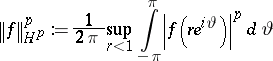 |
is finite. If a function  belongs to
  ,
,  , then there exists a function
  such that
 |
Here, the function
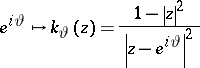 |
is the probability density (cf. also Density of a probability distribution) of a Brownian motion starting at  and exiting
  at
at  . It is the Poisson kernel (cf. also Poisson integral) for the unit disc. A function
  , defined on
  , belongs to
  if there exists a constant
  such that
  , for all intervals
  (cf. also
  -space). Here,
  and
and  denotes the Lebesgue measure of the interval
  . Let
. Let  and
and  be bounded real-valued functions defined on the boundary
  of
of  , and let
  be the boundary function of the harmonic conjugate function of the harmonic extension to
  of
of  (cf. also Conjugate harmonic functions), so that
  is the boundary function of a function which is holomorphic on
  . Then the function
  belongs to
  : see [a4], p. 200, or [a9], p. 295. The function
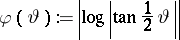 |
belongs to  , but is not bounded; see [a6], Chap. VI. Composition with the biholomorphic mapping
 |
turns  -functions of the line into
  -functions of the circle; see [a6], p. 226.
Martingales in Hardy spaces and in  .
.
Let  ,
,  , be Brownian motion starting at
  and let
  be the filtration generated by Brownian motion (cf. also Stochastic processes, filtering of). Notice that
  ,
,  , is a continuous Gaussian process with covariance
  . Define, for
  , the space of local martingales
  by
by
 |
Here,  . Since the martingales are
  -martingales, they can be written in the form of an Itô integral:
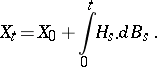 |
Here,  is a predictable random process. Let
  be a
be a  -matrix, and define the
  -transform of
  by
by  . Then the martingale
  belongs to
  if and only all transformed martingales
  have the property that
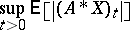 |
is finite; this is Janson's theorem [a8]. A martingale  is called an atom if there exists a stopping time
  such that
i)  if
if  ; and
; and
ii)
 |
Since for atoms  on the event
  , it follows that
 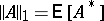 . Moreover, every
  can be viewed as a limit of the form
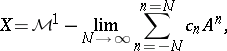 |
where every  is an atom and where
  . A local martingale
  is said to have to bounded mean oscillation (notation
  ) if there exists a constant
  such that
 |
for all  -stopping times
  . The infimum of the constants
  is the
  -norm of
  . It is denoted by
  . The above inequality is equivalent to
 |
Let  be a non-negative martingale. Put
  . Then
  belongs to
  if and only if
  is finite. More precisely, the following inequalities are valid:
 |
 |
 |
For details, see e.g. [a4], p. 149. Let  . Then
  is an unbounded martingale in
  . Two main versions of the John–Nirenberg inequalities are as follows.
Analytic version of the John–Nirenberg inequality.
There are constants  ,
,  , such that, for any function
  for which
  , the inequality
 |
is valid for all intervals  .
.
Probabilistic version of the John–Nirenberg inequality.
There exists a constant  such that for any martingale
  for which
  , the inequality
  is valid. For the same constant
  , the inequality
 |
is valid for all  -stopping times
  and for all
  for which
  .
.
As a consequence, for  integrals of the form
  are finite for
  sufficiently small.
Duality between  and
and  .
.
The John–Nirenberg inequalities can be employed to prove the duality between the space of holomorphic functions  and
and  and between
  and
and  .
.
Duality between  and
and  (analytic version).
The duality between  and
and  is given by
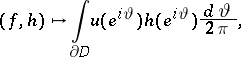 |
where  (
( ,
,  ).
).
Duality between  and
and  (probabilistic version).
Let  be a martingale in
  and let
  be a martingale in
  . The duality between these martingales is given by
  . Here,
  and
and  .
.
There exists a more or less canonical way to identify holomorphic functions in  and certain continuous martingales in
  . Moreover, the same is true for functions of bounded mean oscillation (functions in
  ) and certain continuous martingales in
  . Consequently, the duality between
  and
and  can also be extended to a duality between
  -martingales and
  -martingales.
The relationship between  (respectively,
  ) and a closed subspace of
  (respectively,
  ) is determined via the following equalities. For
  one writes
  and
and  , and for
  one writes
  , where, as above,
  is two-dimensional Brownian motion starting at
  , and where
  . Then the martingale
  belongs to
  , and
, and  is a member of
  . The fact that
  can be considered as a closed subspace of
  is a consequence of the following
 |
 ,
,  ,
,  .
.
An important equality in the proof of these dualities is the following result: Let  and
and  be functions in
  . Then
 |
Here,  ,
,  . A similar convention is used for
  ,
,  . In the first (and in the final) equality, the distribution of
  is used:
  . The other equalities depend on the fact that a process like
  is a martingale, which follows from Itô calculus in conjunction with the harmonicity of the functions
  and
and  . Next, let
  be a function in
  . Denote by
  the harmonic extension of
  to
to  . Put
. Put  . Then
  is a continuous martingale. Let
  be any stopping time. From the Markov property it follows that
  , where
 |
with
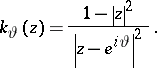 |
As above, the Poisson kernel for the unit disc  can be viewed as the probability density of a Brownian motion starting at
  and exiting
  at
at  . Since the inequality
  is equivalent to the inequality
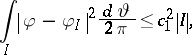 |
for some constant  , it follows that
  can be considered as a closed subspace of
  : see [a6], Corol. 2.4; p. 234.
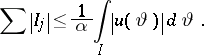
The analytic John–Nirenberg inequality can be viewed as a consequence of a result due to A.P. Calderón and A. Zygmund. Let  be function in
  (
( is some interval). Suppose
  . Then there exists a pairwise disjoint sequence
  of open subintervals of
  such that
  almost everywhere on
  ,
,
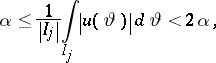 |
and
 |
In [a1], [a6], [a7] and [a10], extensions of the above can be found. In particular, some of the concepts can be extended to other domains in  (see [a6]), in
  and in more general Riemannian manifolds ([a1], [a2], [a7], [a10]). For a relationship with Carleson measures, see [a6], Chap. 6. A measure
  on
on  is called a Carleson measure if
  for some constant
  and for all circle sectors
  . A function
  belongs to
  if and only if
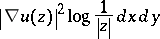 |
is a Carleson measure. Here,  is the harmonic extension of
  . For some other phenomena and related inequalities, see e.g. [a3], [a10], and [a11].
References
| [a1] | M. Biroli, U. Mosco, "Sobolev inequalities on homogeneous spaces: Potential theory and degenerate partial differential operators (Parma)" Potential Anal. , 4 (1995) pp. 311–324 |
| [a2] | S.Y.A. Chang, R. Fefferman, "A continuous version of duality of  with with  on the bidisc" Ann. of Math. (2) , 112 (1980) pp. 179–201 on the bidisc" Ann. of Math. (2) , 112 (1980) pp. 179–201 |
| [a3] | L. Chevalier, "Quelles sont les fonctions qui opèrent de  dans dans  ou de ou de  dans dans  " Bull. London Math. Soc. , 27 : 6 (1995) pp. 590–594 " Bull. London Math. Soc. , 27 : 6 (1995) pp. 590–594 |
| [a4] | R. Durrett, "Brownian motion and martingales in analysis" , Wadsworth (1984) (Contains Mathematica analysis and stochastic processes) MR0750829 Zbl 0554.60075 |
| [a5] | J.B. Garnett, "Two constructions in  " G. Weiss (ed.) S. Wainger (ed.) , Harmonic analysis in Euclidean spaces , Proc. Symp. Pure Math. , XXXV:1 , Amer. Math. Soc. (1979) pp. 295–301 " G. Weiss (ed.) S. Wainger (ed.) , Harmonic analysis in Euclidean spaces , Proc. Symp. Pure Math. , XXXV:1 , Amer. Math. Soc. (1979) pp. 295–301 |
| [a6] | J. Garnett, "Bounded analytic functions" , Acad. Press (1981) MR0628971 Zbl 0469.30024 |
| [a7] | R. Hurri-Syrjanen, "The John–Nirenberg inequality and a Sobolev inequality in general domains" J. Math. Anal. Appl. , 175 : 2 (1993) pp. 579–587 |
| [a8] | S. Janson, "Characterization of  by singular integral transformations on martingales and by singular integral transformations on martingales and  " Math. Scand. , 41 (1977) pp. 140–152 " Math. Scand. , 41 (1977) pp. 140–152 |
| [a9] | P. Koosis, "Introduction to  -spaces: with an appendix on Wolff's proof of the corona theorem" , London Math. Soc. Lecture Notes , 40 , London Math. Soc. (1980) -spaces: with an appendix on Wolff's proof of the corona theorem" , London Math. Soc. Lecture Notes , 40 , London Math. Soc. (1980) |
| [a10] | Jia-Yu Li, "On the Harnack inequality for harmonic functions on complete Riemannian manifolds" Chinese Ann. Math. Ser. B , 14 : 1 (1993) pp. 1–12 |
| [a11] | F.J. Martin–Reyes, A. de la Torre, "One-sided  spaces" J. London Math. Soc. (2) , 49 : 3 (1994) pp. 529–542 spaces" J. London Math. Soc. (2) , 49 : 3 (1994) pp. 529–542 |
| [a12] | G. Weiss, "Weak-type inequalities for  and and  " G. Weiss (ed.) S. Wainger (ed.) , Harmonic Analysis in Euclidean Spaces , Proc. Symp. Pure Math. , XXXV:1 , Amer. Math. Soc. (1979) pp. 295–301 " G. Weiss (ed.) S. Wainger (ed.) , Harmonic Analysis in Euclidean Spaces , Proc. Symp. Pure Math. , XXXV:1 , Amer. Math. Soc. (1979) pp. 295–301 |
John-Nirenberg inequalities. Encyclopedia of Mathematics. URL: http://encyclopediaofmath.org/index.php?title=John-Nirenberg_inequalities&oldid=22609